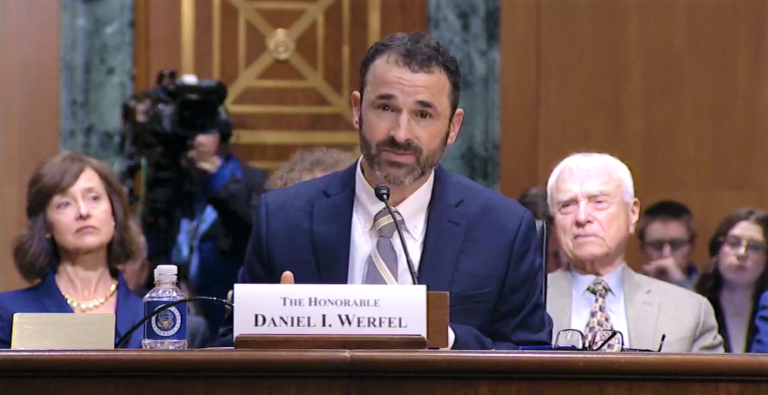
IRS Commissioner Daniel Werfel, pictured at a Senate Finance Committee hearing in February, today announced the agency’s new, expansive plans to enforce federal tax laws in a more equitable way.
…
Artificial intelligence (AI) has been part of the Internal Revenue Service’s arsenal for a while. Now, thanks to more money from the Inflation Reduction Act, the tax agency is going to use more AI to expand its examinations of high-dollar earners.
That includes not only individuals, but also partnerships and corporations.
This shift of compliance efforts will shift the IRS’ focus from working-class to wealthy taxpayers, noted IRS Commissioner Danny Werfel in announcing the revised and expanded enforcement efforts.
“This new compliance push … [will] ensure the IRS holds our wealthiest filers accountable to pay the full amount of what they owe,” said Werfel.
“The years of underfunding that predated the Inflation Reduction Act led to the lowest audit rate of wealthy filers in our history. I am committed to reversing this trend, making sure that new funding will mean more effective compliance efforts on the wealthy, while middle- and low-income filers will continue to see no change in historically low pre-IRA audit rates for years to come,” added the commissioner in a press conference call.
AI focus on large partnerships: The IRS says leveraging AI will help it accomplish its new goals, particularly in connection with large partnerships.
In 2021, the IRS launched the first stage of its Large Partnership Compliance (LPC) program with examinations of some of the largest and most complex partnership returns in the filing population.
The IRS is now expanding the LPC program to additional large partnerships, which on average have more than $10 billion in assets.
By the end of the month, the IRS plans to open examinations of 75 of the largest partnerships in the U.S. that represent a cross section of industries including hedge funds, real estate investment partnerships, publicly traded partnerships, large law firms, and other industries.
The IRS says the AI-assisted selection of these returns is the result of collaboration among experts in data science and tax enforcement. This cutting-edge machine learning technology also will be used to identify potential compliance risk in the international tax, and general income tax and accounting sectors.
“Essentially, these new tools are helping us see patterns and trends that we could not see before. As a result, we have higher confidence on where to look and find where large partnerships are shielding income,” said Werfel.
Prioritizing wealthy taxpayer compliance: In addition to the large partnerships, the IRS says its new enforcement efforts also will look into the tax paid (or not) by the country’s high earners.
In the High Wealth, High Balance Due Taxpayer Field Initiative, the IRS will intensify work on taxpayers with total positive income above $1 million that have more than $250,000 in recognized tax debt.
Building off earlier successes that collected $38 million from more than 175 high-income earners, the IRS says it will have dozens of revenue officers focusing on these high-end collection cases in fiscal year 2024.
The IRS is working to expand this effort, contacting about 1,600 taxpayers in this category that owe hundreds of millions of dollars in taxes.
Audit fairness goal: The IRS says this shift goes hand-in-glove with its planned efforts to improve equity in audits.
Notably, the IRS says it will continue to focus on making improvements in audits involving Earned Income Tax Credits (EITC) claims.
This tax break for low- to moderate-income earners has long been the center of a tax and political storm. The credit is complicated, making it rife with honest mistakes.
The EITC’s complexity also makes the tax credit a favorite tool of tax evaders. Some make false claims themselves. Others con unsuspecting taxpayers into making fraudulent EITC claims.
Current law requires the IRS to hold any EITC-related refunds until mid-February. Audit rates of EITC filers also have held at high levels in recent years, says the IRS, while rates dropped precipitously for those with higher income, partnerships, and those with more complex tax situations.
Werfel said the IRS continues to make improvements in audits involving the EITC, and will be implementing further changes in this area for next filing season. More details will be available later this fall.
Expanded efforts to fight other evasion: This sweeping effort that the IRS says will help restore fairness to tax system also expands to other areas.
Among some of the additional priority areas the IRS will be focused on that will touch the wealthy evaders include —
- Cracking down on crypto. The IRS continues to expand efforts involving digital assets, including work through the John Doe summons effort and last month’s release of proposed regulations of broker reporting. The IRS Virtual Currency Compliance Campaign will continue in the months ahead after an initial review showed the potential for a 75 percent non-compliance rate among taxpayers identified through record production from digital currency exchanges. The IRS projects more digital asset cases will be developed for further compliance work early in Fiscal year 2024.

- More scrutiny on FBAR violations. High-income taxpayers from all segments continue to utilize Foreign Bank accounts to avoid disclosure and related taxes. A U.S. person with a financial interest over a foreign financial account is required to file a Report of Foreign Bank and Financial Accounts (FBAR) if the aggregate value of all foreign financial accounts is more than $10,000 at any time. IRS analysis of multi-year filing patterns has identified hundreds of possible FBAR non-filers with account balances that average over $1.4 million. The IRS plans to audit the most egregious potential non-filer FBAR cases in Fiscal year 2024.
- Longer looks at labor brokers. The IRS has seen instances where construction contractors are making Form 1099-MISC/1099-NEC payments to an apparent subcontractor, but the subcontractor is a “shell” company that has no legitimate business relationship with the contractor. Monies paid to shell companies are exchanged at Money Service Businesses or flowed through accounts in the name of the shell company and returned to the original contractor. The IRS will be expanding attention in this area with both civil audits and criminal investigations. The scheme has already been seen in Texas and Florida. Work in this area is critical to improve compliance, and it will also help level the playing field for contractors playing by the rules as well as ensuring proper employment tax withholding for vulnerable workers.
IRS transformation underway: Werfel said the transformation of the IRS “is continuing at a quickening pace.” The agency has done a “top to bottom review” of its enforcement work, and improving tax compliance among wealthier taxpayers is one of the core parts of what the IRS is doing with the new Inflation Reduction Act funds.
“These are laws already on the books passed by Congress, but the IRS hasn’t had the funding for many years to adequately enforce,” added the IRS commissioner. “We can’t let that situation continue, so it’s critical that the agency addresses fundamental gaps in tax compliance among the wealthy that have grown during the last decades.”
“If you pay your taxes on time, it should be particularly frustrating when you see that wealthy filers are not. We will make the system more fair,” said Werfel.
Tax Felon Friday: Werfel is right. Tax scofflaws are infuriating. Personally, I’m hoping the IRS new compliance programs pay off big time.

When they do catch and, if the case leads to it, convict criminals for evasion, they will become members of the ol’ blog’s Tax Felon Friday feature club.
If you know or suspect a tax crime, check out the IRS’ web page on reporting suspected tax fraud activity. You might even get paid for your information.
You also can catch up on previous tax crime posts, including those that were published long before I gave them a special designation, in the, what else, tax crimes category. You’ll find this post at the top of that collection right now, so just scroll down for more.
You also might find these items of interest:
- Tax audits bring in 3x more money in subsequent years
- Patriotic Millionaires enlist regular taxpayers in tax-the-rich effort
- FinCEN, IRS-CI take steps to stem construction industry payroll tax fraud
- AI start-up gets $12.5M to upgrade, expand tax evasion tracking technology
Advertisements
🌟 Search Amazon Business and Money Books 🌟
The text link above and image links below are affiliate ads. If you click through and then buy a product, I receive a commission.