

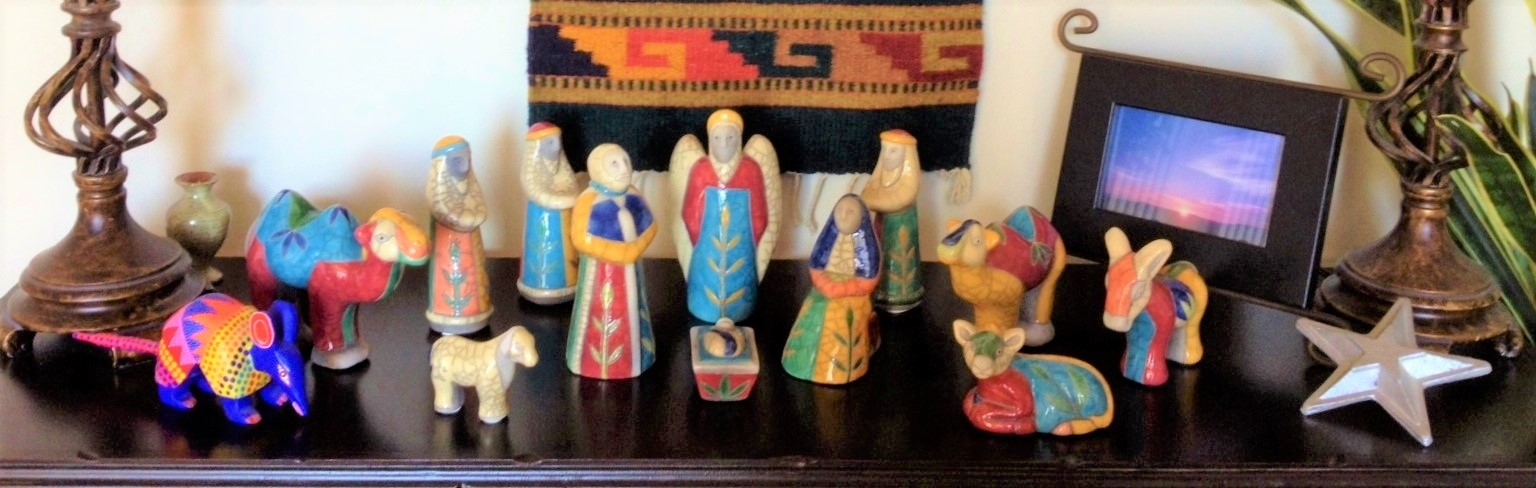
 Photo by Kay Bell
I hope you’re having wonderful holiday, whether you celebrate Christmas for religious reasons or secularly.
I’ve bounced between the two motivations over the years, usually tending toward the ’tis the season for joy and goodwill for all.
However, every December I do put out our Nativity. Yep, that’s it pictured above, our Raku pottery depiction complete with a photograph of a Texas sunset, Lone Star State star, Zapotec textile background and Mexican folk-art armadillo joining the usual stable animals.
Universal, time-honored tale: Church doctrine aside, I love the story of Jesus’ birth and what it tells us about handling difficult situations with grace and love. And nowadays, not to put too fine a point on it, the story of a family seeking a safe place to stay seems to resonate more.
A family under stressful circumstances — Joseph isn’t the father of the baby that Mary, his betrothed, is carrying — leave their home and head to Bethlehem to comply with their government’s order.
They complete the trek as the first-time mother is about to deliver, but things don’t get any easier once they reach their destination. Because so many others already are there, lodging is full and the couple must stay in the innkeeper’s stable, where Jesus was born.
Magical, musical and literary magi: Various Biblical accounts also tell of the shepherds and wise men who came to visit the newborn Christ child.
I’ve always been fascinated by those visitors, especially the wise men, or magi.
As a child, their gifts for baby Jesus of gold, frankincense and myrrh seemed so exotic. Heck, they still do!
My fixation on the gift-bearing trio increased the first time I heard “We Three Kings,” the Christmas carol/hymn musically recounting the magi’s journey to the Bethlehem stable.
A junior high English class further endeared the magi to me. Yep, I’m talking about O. Henry’s short story “The Gift of the Magi.” Nothing could be more romantic to a pre-teen (and still so now to this long-married, much older woman) than how Della and Jim sacrificed their most-prized possessions in order to buy Christmas gifts for each other with, of course, the author’s trademark twist.
In wrapping up his tale, Henry specifically noted the “wonderfully wise” magi, the first to give Christmas gifts.
“But let me speak a last word to the wise of these days: Of all who give gifts, these two were the most wise,” wrote Henry. “Of all who give and receive gifts, such as they are the most wise. Everywhere they are the wise ones. They are the magi.”
Yes, O. Henry and Mr. Barsch reinforced what my mother always told (and still tells) me: In gift giving, it truly is the thought that counts.
That old tax MAGI: And finally, many years beyond middle school, I discovered the tax MAGI.
As most long-time tax-savvy readers of the ol’ blog know, MAGI is the acronym for modified adjusted gross income. The definition in Don’t Mess With Taxes’ glossary is:
This figure is calculated by starting with your adjusted gross income (AGI) and then adding back certain amounts you previously subtracted to get to you AGI. The precise deductions you have to reconsider usually depend on the tax benefit that uses your MAGI. For example, it’s your MAGI, not your AGI, that determines whether you can open or contribute to a Roth IRA. MAGI also affects eligibility for many educational and child-related tax breaks, as well as taxability of Social Security benefits. In each case, how MAGI is figured might be different, so read the instructions carefully.
OK, the Internal Revenue Code’s MAGI is not quite as compelling as the tales from O. Henry and the Apostles. But it’s an important figure in calculating many tax breaks.
Making sure the math is correct could help you save enough tax dollars to buy and extra gift or two for your Jim or Della.
I hope you got all that you wished for on this Dec. 25 and that how ever you celebrate it, today is merry and bright!
via GIPHY
Merry Christmas & Happy Holidays!
