…
It’s a bit hard to keep track if you’re still isolating due to the coronavirus pandemic, but welcome to another Monday federal holiday.
Today is Columbus Day.
Yes, it’s still an official federal holiday. The White House issued an announcement lauding namesake Christopher Columbus that’s getting a lot of pushback on social media from folks who prefer to use this October day to celebrate the United States’ indigenous populations.
We should use this day to learn about the history of indigenous people.
#IndigenousPeoplesDay so for the next 24 hours this account will be a flood of me RTing Native excellence, educational resources, and donation links/GoFundMes/etc. Keep an eye out. pic.twitter.com/apZ9lY13Fb
— American Life🎣🐬💦⛈️🌧️🌩️ (@usambovu) October 12, 2020
Yes, it’s one of those holidays when more private sector retail businesses use it as a hook for product sales than government offices and services close. Got your mattress bargain yet?
And yes, it’s one of those holidays that’s subject to the Uniform Monday Holiday Act. This means the actual date that used to signify a federal holiday is no longer relevant.
Ah, yes, Monday holidays. For the most part the change makes it easier to remember these days, as well as gives many folks a long weekend.
The shifting of holidays to a week day, however, sometimes means that the holidays collide with federal tax deadlines.
IRS deadline timing: The Internal Revenue Service says it considers our tax returns, payments and other required tax actions as being completed on time if they are sent or completed by the tax event’s deadline.
Meet this timely filing requirements and you’ll avoid and penalty and interest charges for being late.
For paper filings, this generally means a U.S. Postal Service postmark on the envelope on the deadline day. For e-filings, it means transmitting on the due date.
Note that for e-filing, the timing when the IRS says you can hit “send” varies depending on the type of transaction, so if you’re pushing your electronic compliance to the very last minute, be sure to check with your tax pro or the IRS.
These deadlines, however, get shifted when they fall on a Saturday, Sunday or a legal holiday. In these cases, the due date is the next business day.
Legal vs. federal holidays: Also take note of the term legal holiday. Most of us tend to think that legal and federal are interchangeable synonyms for these select days.
Not quite.
A federal holiday is one recognized by Uncle Sam by the closure of his offices. The easiest way to determine whether a holiday is considered a federal one is to see whether the U.S. Postal Service delivers mail. Our post offices are part of an independent operation of the executive branch and its employees are federal workers. That means the USPS closes its doors and deliveries on federal holidays.
Sometimes, state and local government offices also are shuttered on federal holidays.
But the IRS has a specific definition for legal holiday. It’s one that is a legal holiday in the District of Columbia.
That’s why Emancipation Day, a Washington, D.C., holiday that’s not widely celebrated across the United States, sometimes comes into play at April tax filing time.
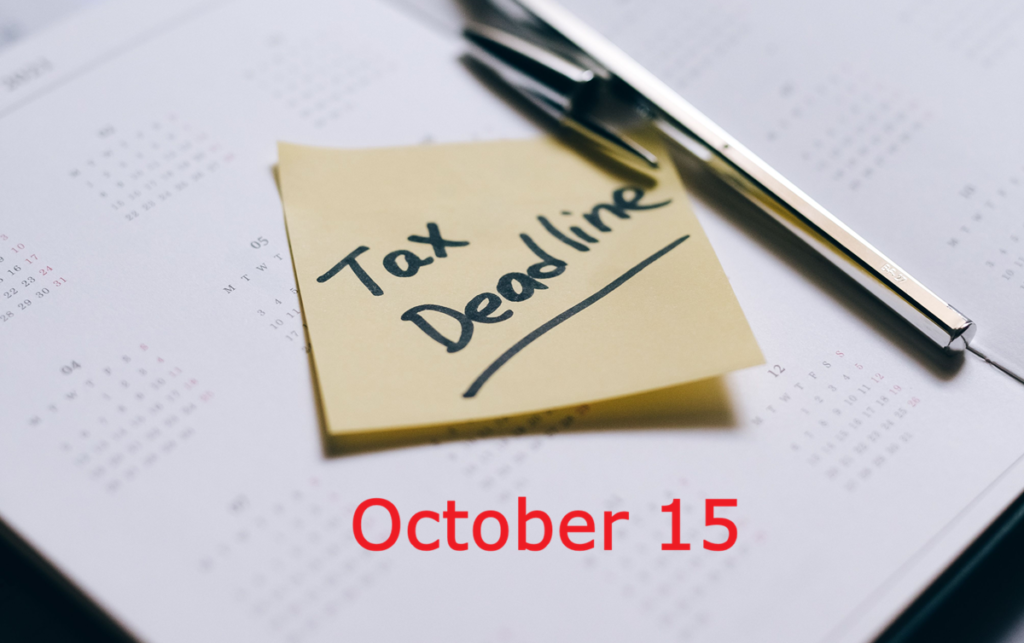
Mark your calendars: The impending — just days away! — Oct. 15 extended tax filing deadline won’t be affected by Columbus Day falling every year on the second Monday of this month.
However, other tax due dates do sometimes fall on holidays. Here are this year’s legal holidays recognized by the IRS:
- New Year’s Day (Wednesday, January 1)
- Birthday of Martin Luther King, Jr. (Monday, January 20)
- George Washington’s Birthday (Monday, February 17; and yep, that’s the holiday’s official name, not Presidents, with or without an apostrophe, Day)
- District of Columbia Emancipation Day (Thursday, April 16)
- Memorial Day (Monday, May 25)
- Independence Day (Saturday, July 4, observed Friday, July 3)
- Labor Day (Monday, September 7)
- Columbus Day (Monday, October 12)
- Veterans Day (Wednesday, November 11; not subject to the Monday holiday law)
- Thanksgiving Day (Thursday, November 26)
- Christmas Day (Friday, December 25)
And here are when they will fall in 2021:
- New Year’s Day (Friday, January 1)
- Martin Luther King, Jr. Day (Monday, January 18)
- Washington’s Birthday (Monday, February 15)
- District of Columbia Emancipation Day (Friday, April 16)
- Memorial Day (Monday, May 31)
- Independence Day (Sunday, July 4, but observed on Monday, July 5)
- Labor Day (Monday, September 6)
- Columbus Day (Monday, October 11)
- Veterans Day (Thursday, November 11; not subject to the Monday holiday law)
- Thanksgiving Day (Thursday, November 25)
- Christmas Day (Saturday, December 25, but observed on Friday, December 24)
- New Year’s Day 2022 (Saturday, January 1, 2022, but observed early on Friday, December 31, 2021)
Yay, two New Year’s Days next year. At least 2021 officially has only one hangover day within its calendar.
One other important thing to note is that some federal holidays are on the same date every year, while others, due to the Monday holiday law, will be on the same day, but on a different date.
And for certain excise taxes, there’s an exception to the next-business-day rule. If you pay these, you can find details in the IRS’ Excise Tax Calendar.
State holidays and taxes: While Emancipation Day could have a nationwide effect on the annual April tax filing deadline, state holidays usually don’t come into play in connection with federal filings and payments.
Usually, however, isn’t always. Sometimes Uncle Sam’s tax collector does make due date adjustments for certain statewide legal holidays.
Typically, a statewide legal holiday delays a due date for filing a federal return only if the IRS office where you’re required to file is located in that state. And any changes are only for those areas, not for taxpayers elsewhere in the country.
This sometimes is the case for Maine and Massachusetts taxpayers. Those states observe Patriots’ Day, the state holiday commemorating the battles of Lexington and Concord, which were fought near Boston in 1775. Patriot’s Day annually is celebrated on the third Monday of April.
Sometimes that third Monday in April also is federal Tax Day.

Painting of the Battle of Lexington by William Barnes Wollen (via Wikipedia Commons).
…
Since the IRS has campuses in Maine and Massachusetts, the IRS gives taxpayers in those states until the next business day to file their federal tax returns. Their state returns already get that automatic extension.
But in most cases, state holidays won’t have any effect on our federal tax filings.
And, reminds the IRS, a statewide legal holiday doesn’t delay a due date for making a federal tax deposit.
You also might find these items of interest:
- MLK Day: Make a difference in the world and possibly on your tax return
- State tax ties to federal tax laws, from shared deadlines, income designations, deductions and more
- National Day of Mourning for George H.W. Bush postpones federal, some state & local tax deadlines