
Taxpayers who were able to use the Internal Revenue Service’s proprietary online tax software to complete and e-file their returns generally liked the free tax-season service. Republicans on Capitol Hill did not.
As is often the case, the politicians won.
The IRS’ Direct File is officially dead. Its obituary is a brief statement on the program’s home page, since deleted but captured in the screenshot below.
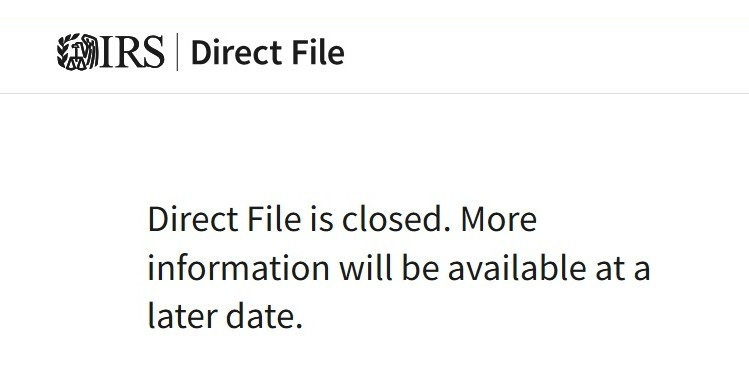
The IRS.gov page also tells visitors that since Direct File is done, they should check out other Uncle Sam approved filing options. They include Free File, which will return in January so that eligible taxpayers can submit their 2025 tax year returns.
Brief, embattled Direct File history: Democratic members of Congress had for years pushed the IRS to offer a no-cost filing option that would save taxpayers from having to pay for commercial software. The IRS option did, however, mimic the tax software manufacturers’ product; it let taxpayers prepare their returns using a system of questions keyed to tax code provisions.
Those who did use Direct File that first year — an admittedly tiny group of 140,000 individual filers in 12 states out of the more than 141 million taxpayers nationwide who submitted returns by mid-April 2024 — were overwhelmingly pleased with the program.
The IRS said the initial Direct File usage was greater than it had projected, and it declared the IRS-run free tax return preparation and electronic filing would be a permanent tax preparation offering.
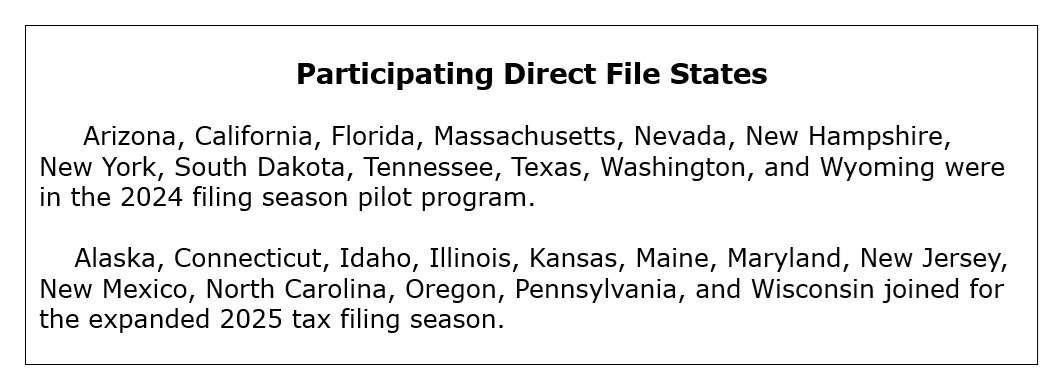
For the 2025 filing season, Direct File added more options, offering, for example, more tax credits that eligible taxpayers could claim, and expanded the program to qualifying taxpayers in 25 states, more than doubling the pilot’s geographic reach.
Direct File was created using part of $80 billion additional funds allocated to the IRS under the Biden administration’s Inflation Reduction Act of 2022 to help modernize the IRS’ operations. Congressional Republicans, already unhappy with the added tax agency money (much of which they eventually clawed back) immediately attacked that approach. They argued that the IRS overstepped in creating Direct File instead of simply exploring such a program.
“Instead of Direct File, the IRS should be focused on improving its functionality and service to American taxpayers,” said 29 Republican U.S. Representatives in a letter delivered to Donald J. Trump on his first day back in the Oval Office. They asked that Trump stop the 2025 Direct File program via an Executive Order.
That didn’t happen, largely because the tax filing season began just days after Trump’s second inauguration. Ending a program on such short notice that any taxpayers were relying would be problematic at best.
And last fall, the IRS asked for public comment on Direct File. The input request was part of the One Big Beautiful Bill Act, which included a mandate that the IRS to create a task force to examine how the agency can use public-private partnerships to replace Direct File.
But apparently, there wasn’t enough support from taxpayers to continue it. (Okay, let’s be honest. No matter what was said, the Trump administration was going to kill Direct File.)
So, the IRS this week (apologies to the Bard) came to IRS.gov to bury Direct File, not praise it.
Next steps for Direct File users: The IRS has notified by email the states that participated in Direct File of the program’s demise. Nextgov/FCW reports that the message let them know “IRS Direct File will not be available in Filing Season 2026,” thanked them for collaborating, and noted that “no launch date has been set for the future.”
Individual taxpayers who used Direct File can no longer log on to the IRS website. Former Direct File users who need a transcript of their filings are instructed to access one through their IRS online accounts.
And, as IRS.gov suggests on the now useless Direct File page, look into other ways to file this coming tax season.
A relatively comparable option is the aforementioned Free File, the IRS’ long-standing partnership with the commercial tax software manufacturers who are part of the Free File Alliance. It has been extended through 2029.
For this last tax season, filers with adjusted gross income of $84,000 or less, regardless of filing status, could use Free File. That income cutoff should increase for the 2026 filing season.