On July 4, 1776, the Declaration of Independence was adopted, marking the newly-formed America’s official break from British colonial rule.
We all know that taxes and the original Tea Partiers were a major part of the creation of the United States.
But what is less well-known is why communities across the country tonight will celebrate the nation’s birthday by setting off pyrotechnic displays. Because Founding Father John Adams said so.
Adams as fireworks advocate: On July 3, 1776, a day after the Continental Congress in Philadelphia voted for independence (the declaration document itself was transposed on July 4, although it took weeks for all the delegates to sign it), Adams reflected on the historic step he and his rebellious colleagues had done.
The man who would become America’s first vice president and its second president put quill to paper to let his wife Abigail, who was at their Boston home, know what had just transpired and how he hoped it would be recognized annually by future Americans:
“I am apt to believe that it will be celebrated, by succeeding Generations, as the great anniversary Festival. It ought to be commemorated, as the Day of Deliverance by solemn Acts of Devotion to God Almighty. It ought to be solemnized with Pomp and Parade, with Shews, Games, Sports, Guns, Bells, Bonfires and Illuminations from one End of this Continent to the other from this Time forward forever more.”
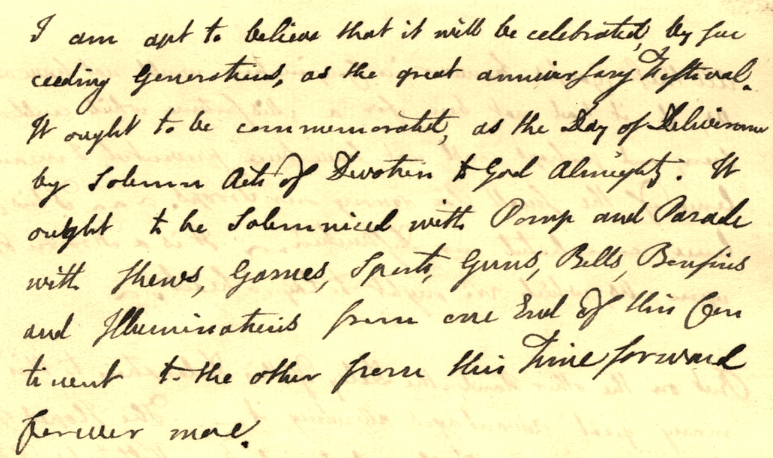
Excerpt from John Adams letter, courtesy the Massachusetts Historical Society, detailing his wish that fireworks be used to celebrate America’s independence. Click image to see the full page.
…
First fireworks in 1777: As Adams wished, the first commemorative Independence Day fireworks were set off on July 4, 1777, in the then-national-capital of Philadelphia. The Pennsylvania Evening Post reported that “the evening was closed with the ring of bells, and at night there was a grand exhibition of fireworks (which began and concluded with thirteen rockets) on the Commons, and the city was beautifully illuminated.”
Fireworks also lit up the 1777 skies in Boston and presumably, per Adams’ wishes, in other cities and towns to celebrate America’s first birthday.
To what I presume is Adams continuing delight as he watches from somewhere in the great beyond, we will again ignite fireworks tonight across the United States in celebration of our country’s 239th birthday.
The purposes of taxes: Unfair taxes levied without representation were a catalyst for the American Revolution. We still hate paying them today, although our discontent is with Uncle Sam, not the King of England, as tax collector.
But taxes are necessary, as Supreme Court Justice Oliver Wendell Holmes famously noted, to pay for a civilized society.
And not only does the federal government collect taxes, but so do the 50 states.
Final fireworks taxes: Here is Texas, we have no income tax, but stiff real property and sales taxes.
And when America’s birthday rolls around and we want to celebrate with noisy and colorful aerial displays, we also have to pay a 2 percent tax on the purchase of fireworks in addition to the usual state and local sales tax amounts. The extra levy funds the rural volunteer fire department insurance fund.
But July 4, 2015, is the last Independence Day that Texas’ fireworks sales tax will apply.
Lone Star State lawmakers eliminated the tax during their last session. On Sept. 1, it will be taken off the Texas tax books. That tax law change earns the final collection of the 2 percent Texas fireworks sales tax this week’s By the Numbers honor.
A Texas Senate analysis of the fireworks tax found that the amount of revenue collected from it was not worth the cost of administering it.
But not to worry volunteer fire departments. You’ll still get your 2 percent. It will just come out of the general sales tax collections on firecrackers, bottle rockets and the like.
More fireworks-eligible holidays: The elimination of the special fireworks tax is estimated to cost the Texas treasury $2.9 million in general revenue over the next two years.
Lawmakers, however, are hoping that some of that money can be made up by additional sales of celebratory explosives.
Previously, Texans could only buy fireworks during the 10 days before New Year’s Eve, Cinco de Mayo and the Fourth of July.
But in addition to snuffing out the fireworks tax, lawmakers also expanded the days that fireworks can be fired off in Texas. We now can purchase fireworks to celebrate Texas Independence Day on March 2, San Jacinto Day commemorating our victory over Mexico on April 21 and Memorial Day.
Buyers will have five days before each of those newly fireworks-eligible holidays to buy the products they want to use for their celebrations.
So next July 4th, and on five other special days within the borders of Texas, fireworks aficionados will be able to celebrate not only the notable events but also the end of the special tax on their chosen pyrotechnics.
You also might find these items of interest: