New tax provisions in the One Big Beautiful Bill (OBBB) Act mean some employees will be eligible for tax deductions related to tip income and overtime compensation.
These taxpayers will need some information from their employers to correctly claim the new tax breaks when they file their tax returns.
How they will get that info for their 2025 filings is unclear. The Internal Revenue Service announced on Aug. 7 that, as part of its phased implementation of the OBBB provisions, it won’t make revisions to certain information returns or withholding tables in connection with tax changes that are effective for the 2025 tax year.
But the tax agency is working on how the OBBB information will be reported for the 2026 tax year. To that end, the IRS has released a draft of next year’s Form W-2, Wage and Tax Statement, reproduced below.
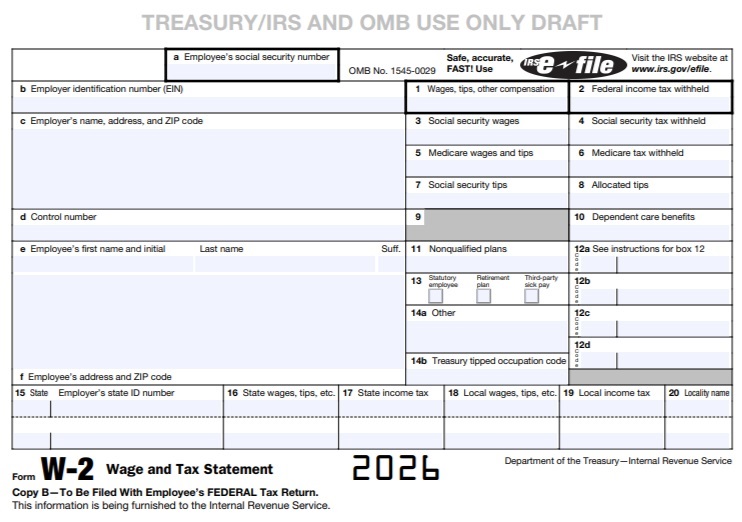
There’s a new box, as well as some changes to facilitate the use of the existing W-2 format in reporting information related to OBBB tax law changes.
Box 12: This box is not new. Taxpayers already are familiar with the amounts, both taxable and nontaxable, that are reported on the Box 12 sublines, shown as 12a, 12b, 12c and 12d.
There are more than two dozen possible entry categories, including such things as contributions to a workplace defined contribution retirement plan, employer-provided adoption assistance, and assorted health-related accounts.
Now, Box 12 also will be used to report information related to new OBBB tax law.
The draft W-2’s instructions say Box 12 is where an employee’s qualified tips are to be entered, and noted by the code TP.
That same box also is where any qualified overtime compensation would go, noted in this case by the code TT.
And if a company makes contributions to an employee’s Trump account for young children, that amount would go Box 12 and be denoted by code TA.
Box 14b: The draft Form W-2 also expands the existing Box 14.
Now, instead of just being Box 14 where “Other” amounts go, the box is split into 14a Other and 14b Treasury tipped occupation code.
The new Box 14b segment is where employers will report eligible employees’ qualifying occupation that allows them to exclude up to $25,000 in tip income.
The IRS has an Oct. 2 deadline to publish the official list qualifying occupations that allow for the claiming of the no-tax-on-tips deduction. It’s expected that list will include the codes that will be used in Box 14b.
The tax agency also notes that the 2026 Form W-2 is an early release draft, and that it may make additional changes before the income statement is finalized for use.
For now, though, these changes are more than enough to qualify next year’s Form W-2 as this week’s By the Numbers figure.
You also might find these items of interest:
- Treasury and IRS want your thoughts on digital assets and Direct File
- OBBB increases reporting thresholds for 1099 forms K, MISC, and NEC
- No changes this year to withholding tables or tax forms affected by OBBB
Advertisements
🌟 Search Amazon Tax Products 🌟
The text link above is an affiliate ad. If you click through and then buy a product, I receive a commission.