If you’re still working on your tax return, chances are you owe Uncle Sam.
Your payment deadline is Monday, April 15. That’s also the day you must send in either your completed Form 1040, 1040A or 1040EZ. Failure to do either (or both) will cost you more in penalties (although the IRS says it will cut some folks some penalty slack this screwy filing season) and interest.
In general, though, the penalty for not filing or sending in a Form 4868 to get a six-month extension is larger than for not paying. But you’ll still be slapped with some extra charges for not paying.
E-filing popularity leads to more e-payments: Just as the Internal Revenue Service has made it easier to file online (and at no cost for many taxpayers who use Free File), the federal tax collector also has made it easier to pay what you owe electronically.
Your electronic tax payment options are today’s Daily Tax Tip. Here are three easy ways.
1. Credit or debit card
You can pay your annual tax liability by debit or credit card regardless of whether you e-file or send in paper forms.
When you e-file and owe, your tax software will ask if you want to pay and give you this option. If you send a paper return, you can call the authorized credit and debit card payment processors and pay your bill that way.
IRS-Approved Credit or Debit Card Tax Payment Processors
|
Company, Website Link |
Debit Card Flat Fee |
Credit Card Fee |
| Official Payments Corp. Official Payments 888-872-9829 Payment 800-487-4567 Live Operator 877-754-4413 Services |
$3.95 |
2.35% |
| Official Payments Corp. ChoicePay 866-964-2552 Live Operator |
$3.48 |
1.88% |
| Link2GovCorporation Pay1040.com 888-729-1040 Payment 888-658-5465 Service |
$2.99 |
2.35% |
| WorldPay US, Inc. PayUSAtax.com 888-972-9829 Payment 888-877-0450 Live Operator 877-517-4881 Service |
$3.49 |
1.89% |
All accept Visa or MasterCard. Some also take Discover, American Express and a variety of debit cards.
While using plastic to pay your tax bill is easy and if you are enrolled in a rewards program could get you some extra points, remember that if you don’t pay off your charge card balance, you’ll owe interest on that amount.
To make a credit or debit card payment, you’ll need the following information:
- The primary Social Security number (the first person listed on the return) and, if it’s a joint return, the spouse’s Social Security number
- Charge or debit card number and expiration date
- Your billing address information
- The amount of tax payment you want to make
- Your e-mail address for confirmation of payment (Internet payment only)
- Your daytime phone number
When you get your card’s monthly statement, your tax payment will be listed as “United States Treasury Tax Payment.”
The convenience fee paid to the service provider will be listed as “Tax Payment Convenience Fee” or something similar. Note that this processing fee could be counted as an itemized tax deduction on next year’s return.
2. Electronic Funds Withdrawal (EFW)
Electronic Funds Withdrawal, or EFW, allows Uncle Sam to get his due money directly from your bank account and put it into the U.S. Treasury.
There’s usually no charge for EFW transactions, which are essentially the reverse of direct deposit that millions of taxpayers use to get their refunds.
You’ll need your financial institution’s routing transit number and your saving or checking account number.
If you’re using a checking account, look at your paper checks. The example below shows where these digits are typically located.
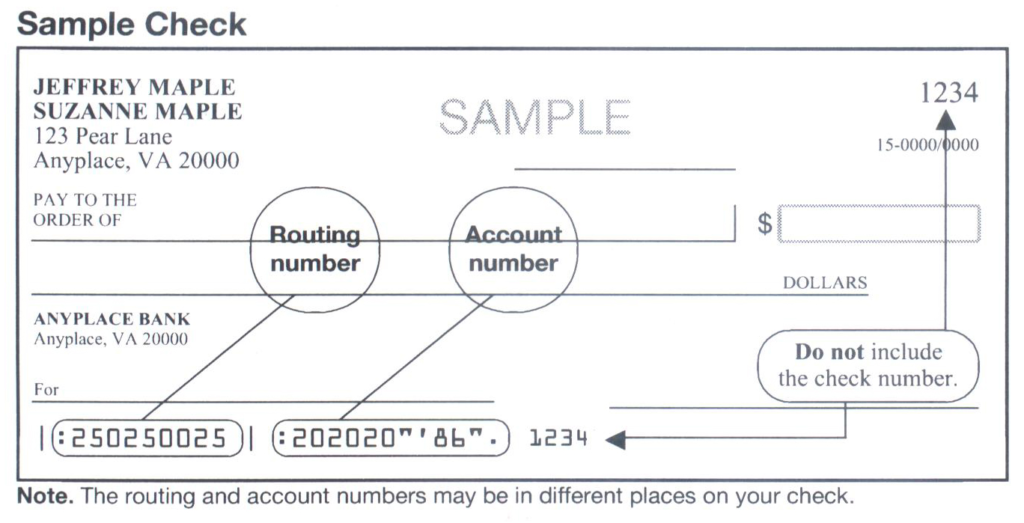
But double check with your bank to confirm the numbers, especially the routing data. Your bank could use a special routing code for government transactions.
3. Electronic Federal Tax Payment System (EFTPS)
Long-time readers of the ol’ blog know I’m a fan of EFTPS, or the IRS’ special Electronic Federal Tax Payment System.
If you’re not already enrolled, you can use this payment method for this year’s filing since EFTPS requires some set-up time. But when you’ve wrapped up this tax season’s tasks, check out EFTPS.
You can use the system to pay a variety of business and individual tax bills throughout the year, including estimated tax payments, the first of which for the 2013 tax year also is due on Monday, April 15.
You also might find these items of interest: