


Photo by Supannee U-prapruit on Unsplash
It’s tax filing time again. And this year, many taxpayers will find that some retroactive provisions in the One Big Beautiful Bill Act (OBBBA) will come into play when they fill out their tax returns. Here’s a look at eight tax law changes that could affect your 2025 tax year filing.
Congress is notorious for making tax law changes retroactive. Too often, federal lawmakers don’t act until the end of the year. That gives us taxpayers little or, realistically, no chance to make tax moves related to the suddenly effective new tax provisions.
We got lucky last year. The Republicans’ massive tax reform measure, the One Big Beautiful Bill Act (OBBBA), was signed into law on July 4, 2025. That gave us six months to prepare.
But the fireworks meant it was summer. School resumed a few months later. Then the holidays were here. So, even if we were curious about the OBBBA tax changes, life redirected our focus.
Now, however, tax season 2026 is here. And that means it’s time to reacquaint ourselves with just what OBBBA might mean to our 2025 tax returns.
1. Larger standard deductions: Every fall, the Internal Revenue Service announces inflation adjustments to a variety of tax provisions. The annual changes to the standard deduction amounts affect most taxpayers. Thanks to OBBBA, the deduction levels were hiked even more.
Single filers — that’s unmarried taxpayers and married partners filing separate returns — now can claim $15,750 as their standard deduction on their 2025 tax return. Heads of households’ standard amount is $23,625. Married couples who file a joint Form 1040, as well as surviving spouses, can claim a standard deduction this filing season of $31,500.
2. Bonus tax deduction for senior citizens: Older taxpayers already get a bump to their standard deduction amount. OBBBA sweetens their filing pot even more. The new tax law’s so-called Senior Bonus could net qualifying filers age 65 or older an added maximum $6,000 deduction.
That six grand goes to eligible filers with a modified gross adjusted income (MAGI) of up to $75,000. The income threshold for older couples filing joint returns is $150,000. The Senior Bous is phased down, and ultimate out, for filers whose MAGI exceeds their filing status income cap.
3. New savings account for some newborns: There’s also a new tax benefit on 2025 tax year returns at the other end of the age spectrum. Some families will be able to sign up for this new child savings account, dubbed the Trump Account, this year.
The account starts with a $1,000 deposit from Uncle Sam for children born in 2025 through 2028. Future years’ annual contributions are subject to limits and rules. To open one, you can fill out Form 4547 and submit it with your tax return. And yes, the IRS document was intentionally named for Donald Trump’s 45th and 47th presidential terms.
If you’re not ready at filing time to establish a Trump Account for your newborn, no worries. The IRS says an online portal to handle the accounts should be operational by this summer. You also can start adding funds to the custodial account in July.
4. No tax on some tips: Trump promised during the presidential campaign that he’d eliminate the federal tax on tip income. OBBBA sort of does that. Starting with 2025 tax return filing, eligible filers can deduct up to $25,000 of qualified tips annually from their taxable income. But, as with all things tax, there are requirements and limits.
The deduction is phased out for single taxpayers with MAGI exceeding $150,000. The MAGI cap is $300,000 for married filing jointly taxpayers. And the tipped taxpayer must work in a field where tips are customarily and regularly received. The IRS’ official list includes leased a list of 68 occupations.
But there is some good filing news. The deduction is available for regardless of whether you itemize or claims the standard deduction.
5. No tax on certain overtime: Some workers who get overtime pay also get a new tax break on their 2025 return. They may be able to deduct up to $12,500 of qualified overtime compensation on their taxes. The maximum deduction is $25,000 for married couples who file a joint return).
But, as with the tip income tax break, the overtime write-off is phased out, and possibly eliminated, for single files with MAGI of more than $150,000 and $300,000 for jointly filing couples.
And, as with the tip income break, the overtime deduction can be claimed by both itemizing and standard deduction claiming taxpayers.
6. No tax on specific car loan interest: Individuals who got a loan to buy an eligible vehicle for their personal, not business, use last year might be able to claim a tax deduction of up to $10,000 on the loan’s interest. The key here is whether the car (or other qualifying vehicles, including light trucks, SUVs, and motorcycles) was assembled in the United States.
This OBBBA provision also phases out for vehicle buyers whose income is larger, starting at $100,000 of MAGI for single filers, and $200,000 MAGI for jointly filing taxpayers.
7. Increased adoption tax credit: The tax code has long offered help to families that seek to grow via adoption. The existing adoption tax credit for 2025 filings of up to $17,280 for each adoptee remains.
But OBBBA improved the tax credit, which already was pretty darn good since as a credit if offers a dollar-for-dollar reduction in any tax you owe. Starting this year, up to $5,000 in qualifying adoption expenses are refundable.
As the description indicates, instead of losing any adoption tax credit left over after you zero out the tax you owe, you can get the excess credit as a tax refund.
8. Larger itemized SALT deduction: The OBBBA spices up the amount of state and local taxes, referred to as SALT, that can be claimed on Form 1040’s Schedule A. But these added claims for income, sales, and property taxes that are deductible from federal income will be available only for a limited time.
The previous $10,000 cap goes to $40,000 for 2025. It will be bumped up by 1 percent annually for tax years 2026 through 2029, before returning in 2030 to the $10,000 limit. In addition, the SALT amount is phased out for taxpayers with modified adjusted gross income (MAGI) of more than $500,000.
Many tax breaks temporary: As noted in the SALT increase discussion, that tax break is temporary. It is not alone in facing an expiration date.
In order to balance the political needs of providing individuals taxpayer, aka voters, with tax benefits and the already exorbitant cost of the OBBBA, Congress opted to make some of the bills’ 105 tax provisions temporary. Specifically, seven of the tax changes have expiration dates.
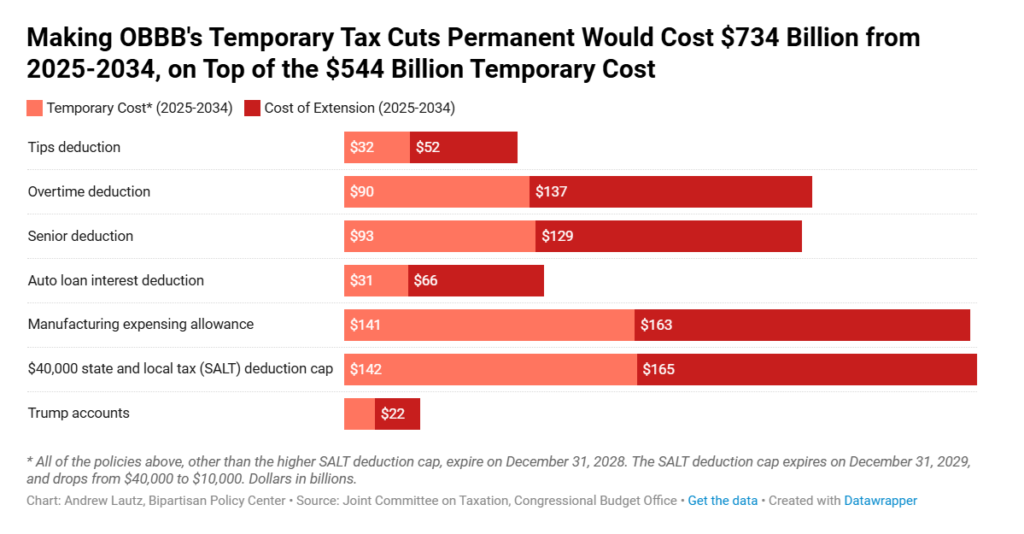
The deductions for tip and overtime income, vehicle loan interest, and the Senior Bonus, as well as federal contributions to Trump Accounts, will expire on Dec. 31, 2028. The SALT increase will expire on Dec. 31, 2029.
The chart below, created by Datawrapper and published by the Bipartisan Policy Center, illustrates the cost of the individual temporary tax provisions (and one for businesses).
Right now, however, 2025 is the tax year focus. Whether these expiring tax breaks will be extended is something to worry about as their end dates near. Trust me, Congress probably will wait until the last minute to take any action.
State taxes, too: Finally, if you live in a state that collects tax from its residents’ earnings, and that’s most of them, be aware that these new federal tax laws may or may not affect your state filing this year.
Most states tend to rely on our federal filings, with many using the information we send to the IRS every year as the starting point for calculating state taxes. Because of that connection, some states automatically conform to federal changes, but not all. They pick and choose, via legislative action, which federal tax laws will apply in their jurisdiction.
For example, Colorado lawmakers met in a special session last August to, in part, deal with the $750 million hole the OBBBA had created in the Centennial State’s budget. They opted out of exempting overtime pay from state income taxes.
This state-by-state choice to either conform or decouple from federal tax laws can be confusing. If you have questions, check with your state’s tax department, or even better, consult a tax professional familiar with your state’s tax laws.
You also might find these items of interest:
- New OBBB tax breaks taking effect in 2025
- Get ready to file and other January 2026 tax moves
- New tax law changes present challenges to IRS and taxpayers
Advertisements
🌟 Search Amazon Tax Products 🌟
The text link above is an affiliate ad. If you click through and then buy a product, I receive a commission.
Kay Bell
thanks for the alert. I’ll double check, but it shows up OK on Edge, the newest version of IE, on all my devices