
Photo by Sara Kurfeß on Unsplash
…
Gas taxes are a top concern of drivers right now. But if you’re pumping the fuel into a rental vehicle, that’s just one of many taxes you’ll face. Half your rental car bill may be taxes and fees, according to research by a tax policy group.
…
You don’t have to own a car to feel the effect of higher fuel prices.
Delivery fees are likely to increase as companies look to offset added the higher tax on the diesel those heavier vehicles use. Also expect hikes in fares for gasoline-powered cab and on-demand ride services.
Then there are rental cars.
When you get a filled-up vehicle at the airport or other rental location, you can be sure the higher fuel rates are applied to your contract. If you drive the loaner for a while, you will directly pay the higher pump prices.
But gas isn’t the only tax on this short-term transportation. In renting a car, half your bill may be taxes and fees, according to research by the Tax Foundation.
“Rental cars are some of the most heavily taxed transactions in the United States,” write excise tax specialists Adam Hoffer and Jacob Macumber-Rosin at the Washington, D.C.-based tax policy organization’s website.
An added 11 percent travel tax: Their research indicates that last year the median state rental car tax was more than 11 percent.
Customers in Minnesota, Colorado, and New York paid the most. Customers in those three states, customers were charged an average tax of more than 20 percent for a standard rental car transaction.
And if you rent a vehicle in a major U.S. city, the transactions is taxed even more heavily because municipal taxes stack on top of the state-charged rates, say Hoffer, director of excise tax policy at the Tax Foundation, and Macumber-Rosin, excise tax policy analyst at the organization.
That’s why Chicago levies the steepest taxes on rental cars among the cities they studied, despite Illinois imposing one of the lower tax rates on rental vehicles.
The Tax Foundation map below gives you an overview of the various and varying rental care taxes across the country.
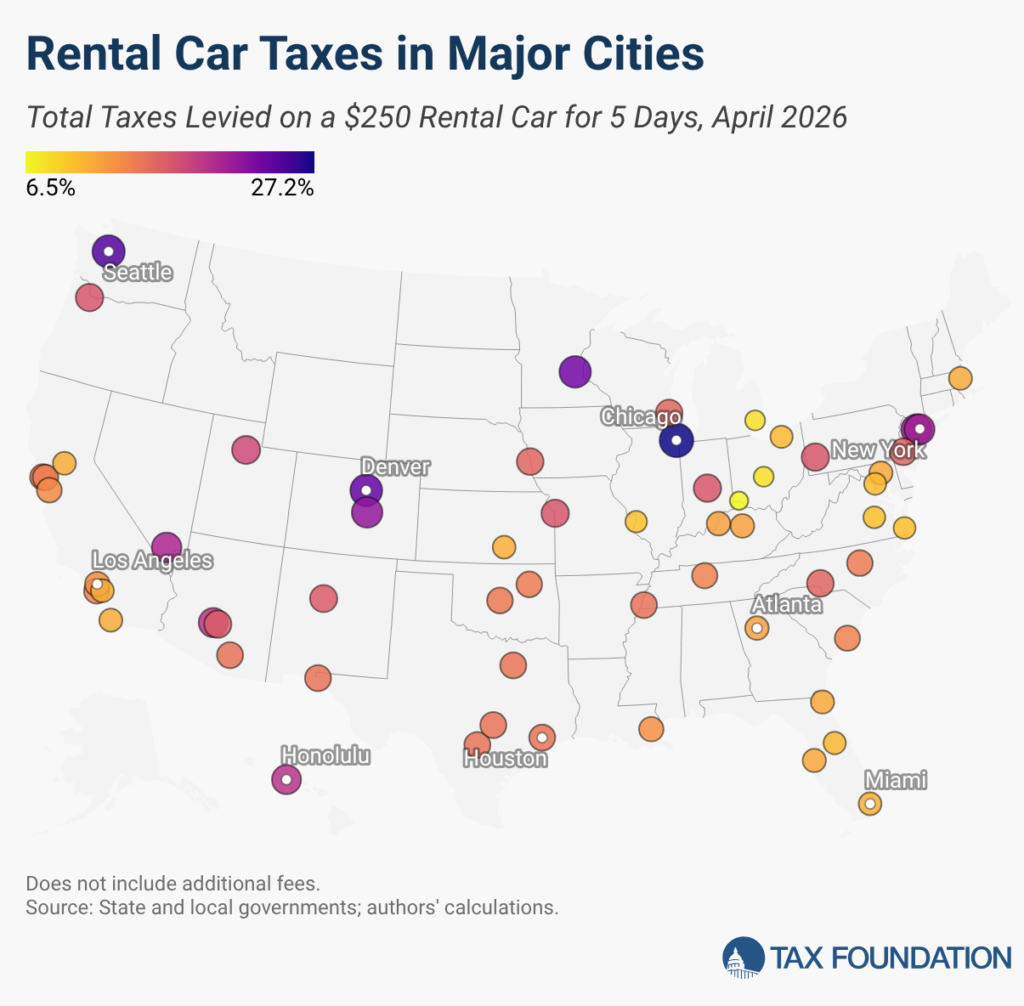
Highest and lowest rental car taxes: After Chicago’s combined total tax of 27.2 on a rental, the other cities where a rental car will really cost you are —
- Seattle, Washington at 24.8 percent;
- Denver, Colorado at 23.9 percent;
- Minneapolis, Minnesota at 23.3 percent; and
- Colorado Springs, Colorado at 21.9 percent.
Those municipalities are among the nine cities that have a rental car tax rate exceeding 20 percent.
On the other end of the spectrum, Cincinnati, Ohio, charges the lowest tax on rental cars at 6.5 percent.
Other relative rental car tax bargains can be found in Detroit, Michigan, and Columbus, Ohio, which both levy a total tax of 8.0 percent. St. Louis, Missouri, at 9.7 percent; Virginia Beach and Richmond, Virginia, both at 10 percent; and Washington, D.C. at 10.25 percent round out the least taxed cities for rental cars in the Tax Foundation study.
More vehicle rental tax data: You can find more on how the various jurisdictional taxes affect rental car rates in the Tax Foundation analysis by Hoffer and Macumber-Rosin.
They also include a table detailing the total taxes and fees shown in their map.
And as for that map, all y’all who prefer a more visual representation can find the information in the Tax Foundation’s interactive version.
The data won’t thrill you, but it should help you create a more accurate travel budget.
You also might find these items of interest:
- Car owner’s manual for the new vehicle loan interest deduction
- Tax-free family vehicle transfer is en route to Wyoming this summer
- Business mileage tax deduction rate goes up in 2026, but two others are cut
…
Advertisements
🌟 Search Amazon Tax Products 🌟
The text link above is an affiliate ad. If you click through and then buy a product, I receive a commission.