

Everyone needs money. Most of us get the cash to cover our lives’ expenses via a salary.
But Ray Madoff, a professor at Boston College Law School who specializes in tax law and estate planning, says salaries are for suckers.
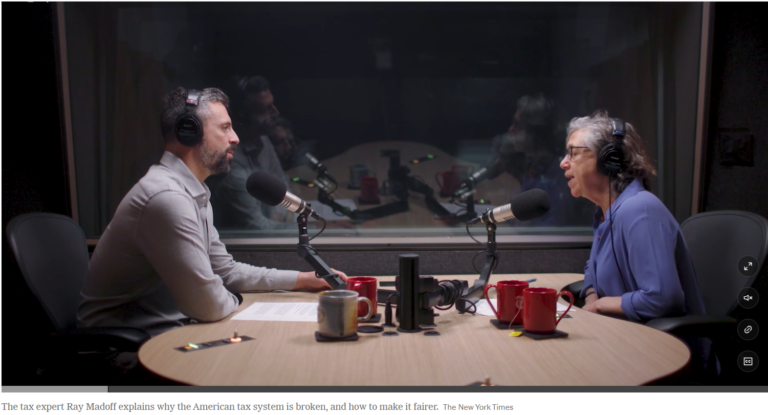
That assessment came as Madoff talked with Ezra Klein during an episode of his eponymous New York Times podcast. The salary take is one reason why, per the newspaper’s coverage of the conversation, Our Tax System Should Make You Furious.
You can watch the podcast, which is a bit over an hour, or read the edited transcript.
Why salaries are for suckers: Madoff’s elaboration on why we wage slaves are suckers also gives the ol’ blog this week’s By the Numbers figure. It’s $82,000.
That 82 grand, says Madoff, is the amount of salary Jeff Bezos, who owns the space technology company Blue Origin and the Washington Post, has received as an annual salary from his first successful venture, the now ubiquitous Amazon.
$82,000 is a nice annual pay level. I, and many others, could make that work. But, Bezos and his colleagues in the richest-of-the-rich club don’t need or want salaries. Instead, they prefer to get their pay from sources that aren’t subject to the U.S. tax code’s ordinary income tax rates.
So, instead of getting pay on which they would owe a 37 percent income tax rate, they typically get paid in their companies’ stock. Then, they don’t owe tax until they sell those assets at a profit. And then, that capital gains tax rate is substantially lower, a top 20 percent rate, than the levy on wages.
Plus, they use the stock as collateral for loans, which provide the money they need to support their lifestyles.
Or, as Madoff says in the podcast —
“Let’s focus on Jeff Bezos because he’s much more of a classic case. Jeff Bezos started his own business. He owns a dominant amount of the stock.
And over the course of the years, he has taken a salary that is no higher than $82,000. It’s been more than 20 years now, and his salary is always capped at $82,000.
You might say: Well, why would it be? He started the company — he’s the man. Why isn’t he taking a huge salary to reflect all that he put into the company?
The reason is: Salaries are for suckers. When people take a salary, they’re subject to high income taxes and payroll taxes, and Jeff Bezos and a lot of our other multibillionaires have no interest in paying those taxes.”
…..
Other tax code income disparities: Klein and Madoff also discuss the 2021 ProPublica piece based on actual leaked tax documents of the wealthy. The online journalism site’s investigation revealed that the wealthy taxpayers actually paid a tiny amount of tax, most of their rates hovering around 1 percent. Or less.
Quick aside. The former Internal Revenue Service consultant who gave ProPublica the tax material is now in jail, because it’s illegal to share other people’s federal tax data. Donald J. Trump, whose filings were part of the trove, is trying to get $10 billion of our tax dollars as compensation from the IRS, which he argues failed to take the necessary steps to prevent the unauthorized release of his tax documents. But that’s for another post.
Klein and Madoff also look at the differences in the ways the rich and we regular income earners are taxed. Madoff also elaborates on the loopholes in the federal estate tax, such as the estate tax exemption. That 2026 amount was increased under the One Big Beautiful Bill Act to $15 million per person ($30 million for married couples), allowing larger estates to keep even more from Uncle Sam’s clutches. The estate tax exemption amount will continue to be indexed for inflation.
And, of course, the growing interest in wealth taxes, at both the state and federal levels, is part of the pair’s discussion.
But this weekend, just after millions of us filed 1040s that reported mostly the money we earned from our jobs, the salaries are for suckers comment kind of hit home.
You also might find these items of interest:
- IRS apologizes to billionaire whose tax info was leaked
- Why the rich pay at a lower tax rate than the rest of us
- March tax bracket madness, or what’s your real tax rate?
…..
Advertisements
🌟 Search Amazon Tax Products 🌟
The text link above is an affiliate ad. If you click through and then buy a product, I receive a commission.


Viki Wu
The $82,000 figure is a good hook, and it’s worth putting a number on the other side of it so readers see how much of the gap is the paycheck itself. A wage earner on $82,000 in 2026 has federal income tax withheld on roughly $66,000 of taxable income (after the $16,100 standard deduction), which works out to a bit over $9,000, plus $6,273 in Social Security and Medicare that comes out of every check before they ever see it — so around $15,000 gone, or 18–19% of gross, before state tax. The same $82,000 taken as long-term capital gains by a married filer would owe zero federal tax, because the 0% capital-gains bracket runs to $98,900 of taxable income for joint filers in 2026, and none of it is subject to FICA at all. That’s the real “suckers” arithmetic: it’s not only the 37% vs. 20% top-rate comparison, it’s that wages carry a 7.65% payroll tax on the first dollar (15.3% if you count the employer share that would otherwise be pay) and investment income carries none. Madoff’s point about borrowing against stock instead of selling is the third leg — no sale, no gain, no tax, and the loan interest is often cheaper than the capital-gains rate would have been.
Comments are closed.