


While Department of Government Efficiency (DOGE) personnel are looking for Social Security benefits they believe were fraudulently sent to very old, probably deceased individuals, Uncle Sam’s official tax watchdog has a different take.
The Treasury Inspector General for Tax Administration (TIGTA) recently examined situations where Uncle Sam owes taxpayers who passed away.
TIGTA found, in its report 2025-IE-R12 issued March 12, that “Improvements Are Required to Promptly Validate and Issue Manual Refunds Associated With Deceased Taxpayers.”
Overall, TIGTA’s analysis found that in the more than 440,000 final filings it reviewed, survivors were owed a total of $1.3 billion in refunds. It also discovered that they have been waiting on average more than a year for the money.
IRS questions about final refund process: The oversight group said it conducted the evaluation after an IRS employee expressed concerns that tax refunds associated with deceased taxpayers were not being processed in a timely fashion.
A deceased taxpayer may be owed a federal tax refund if, for example, they die before receiving a refund on a tax return they filed. The refund also may be associated with the legal required final tax return that is completed and submitted by the taxpayer’s surviving spouse, estate executor, or beneficiary on behalf of the deceased person.
Such delays mean that survivors of these deceased taxpayers are “experiencing an undue hardship in receiving the tax refunds to which they are entitled,” notes TIGTA.
Manual refunds investigated: To examine the problem, TIGTA looked at nearly 610,000 manual refunds the IRS issued from January 2021 to July 2024 for deceased taxpayers.
TIGTA found that during that time period there were 440,443 cases of deceased taxpayers due a refund. The total owed survivors was $1.3 billion.
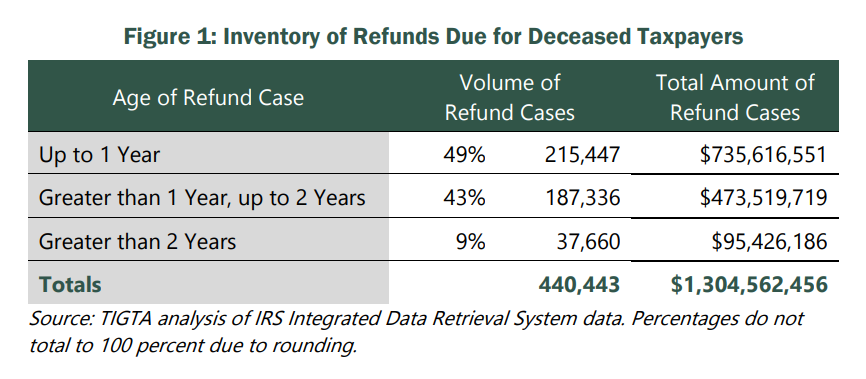
TIGTA also discovered that it took the IRS an average of 444 calendar days to process and issue these decedent’s manual refunds.
It also discovered that the refunds included more than $237 million in interest paid. TIGTA also estimated that the IRS miscalculated the interest for more than 47,500 claimants. This resulted in the claimant receiving either too much or too little interest.
IRS working to improve the process: The good news, TIGTA notes in the report, is that the IRS currently is developing programming to either eliminate or significantly reduce the need for manual refunds for those who claim a deceased taxpayer’s refund.
“As the name implies, the manual refund process is labor intensive in the respect that it requires employees to complete the refund request paperwork which goes through at least two levels of additional review before issuance,” wrote Kenneth C. Corbin, chief of the IRS’ Taxpayer Services Division, in response to TIGTA’s report.
“Programming is expected to be implemented in April 2205 that will permit employees processing these refund claims to update accounts with the additional information identifying the representative of the decedent and releasing the refund for systemic payment,” added Corbin.
He also noted that the IRS has initiated development of an electronic workflow that will automate the system of processing the additional filings that are required in the cases of some deceased taxpayers’ returns.
More details on the TIGTA examination and IRS response to the group’s other recommendations are in the report.
You also might find these items of interest:
- Proposed IRS layoffs could cost U.S. $2.4 trillion
- TIGTA celebrating 25 years of keeping an eye on the IRS
- TIGTA cites online tax prep info sharing issues for filers and IRS
Advertisements
🌟 Search Amazon Tax Products 🌟
The text link above is an affiliate ad. If you click through and then buy a product, I receive a commission.
