

It’s been a tax crazy July and we’re just a week into the month.
There’s the One Big Beautiful Bill (OBBB) Act that was signed into law on July 4. We’re all still sorting through its many provisions to see just how it might help us on our 2025 taxes and beyond.
Most states also saw various new or revised tax laws kick in on July 1.
One state levy that affects most Americans is the sales tax. It’s collected by 45 states and the District of Columbia. Even in Alaska, one of the five states without a sales tax, local Last Frontier jurisdictions can impose a sales tax if they so choose.
Sales tax amounts also tie into federal taxes, since they can be counted as an itemized deduction on Schedule A by taxpayers who choose that route.
More might be itemizing in the next few years since the OBBB increased the state and local taxes (SALT) cap for certain taxpayers from $10,000 to $40,000 for tax years 2025 through 2029.
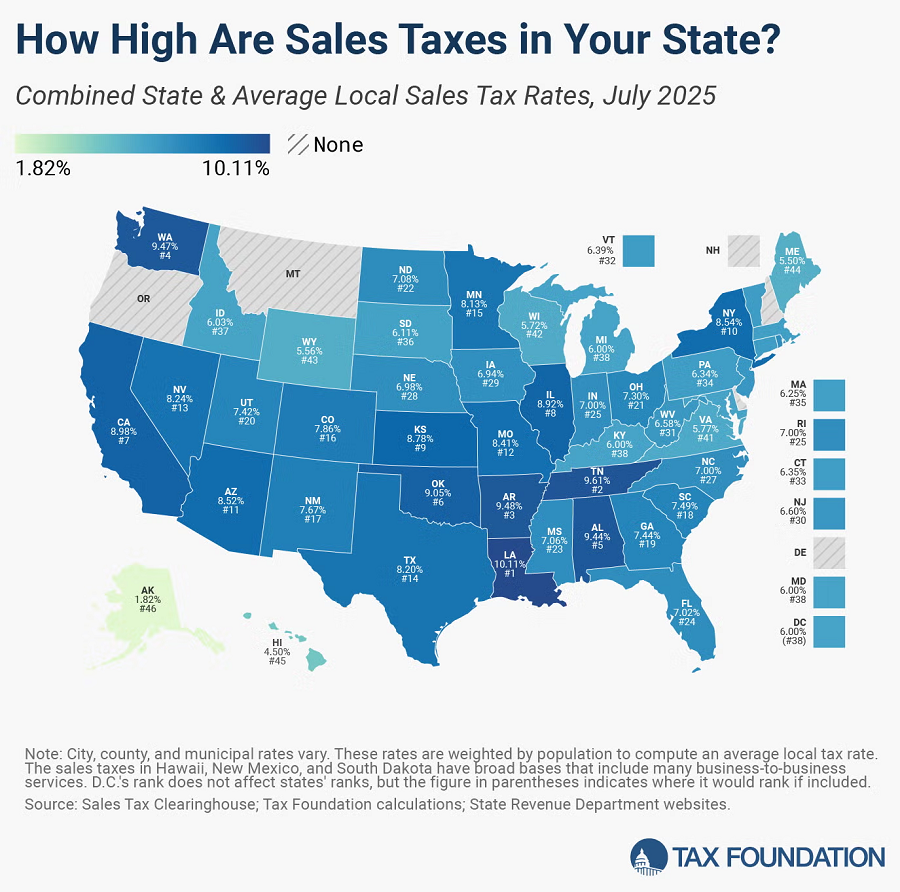
Sales taxes nationwide: So, just how high are your state’s sales taxes? The Tax Foundation has an answer.
As of July 1, the population-weighted average sales tax rate across the United States is 7.52 percent, up from 7.49 percent in January, according to the tax research think tank.
Excluding the five states without statewide sales taxes — joining the previously mentioned Alaska are Delaware, New Hampshire, Montana, and Oregon — the weighted average rate has risen from 7.68 to 7.72 percent.
As for specific state sales taxes, Tax Foundation researchers report that the five states with the highest average combined state and local sales tax rates are —
- Louisiana at 10.11 percent,
- Tennessee at 9.61 percent,
- Arkansas at 9.48 percent,
- Washington at 9.47 percent, and
- Alabama at 9.44 percent).
At the other end of the sales tax spectrum, the five states with the lowest average combined rates are —
- Alaska at 1.82 percent,
- Hawaii at 4.50 percent,
- Maine at 5.50 percent,
- Wyoming at 5.56 percent, and
- Wisconsin at 5.72 percent.
You can see how your state’s sales tax rate compares in the Tax Foundation map below. You also might want to check out the organization’s interactive version.
You also might find these items of interest:
- Maximizing your Schedule A itemized tax deductions
- ‘We’re #47!’ That’s Austin’s ranking in U.S. city sales tax rates
- July 4 holiday motorists in 12 states are paying higher gasoline taxes
Advertisements
🌟 Search Amazon Home Audio Products 🌟
The text link above is an affiliate ad. If you click through and then buy a product, I receive a commission.

