

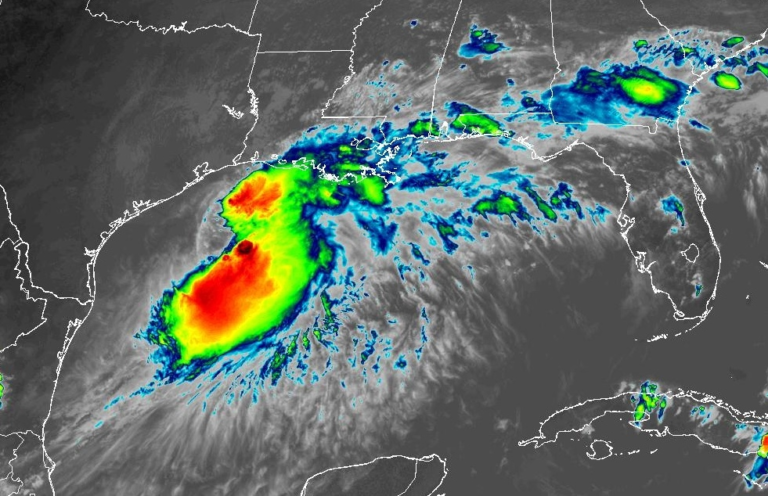
Tropical Storm Arthur as it neared landfall along the Texas coast on June 17. GOES satellite image via National Oceanic and Atmospheric Administration (NOAA)
…
The 2026 Atlantic/Gulf of Mexico hurricane season’s first named storm hit the Texas Coast on June 17. Its tragic landfall underscores the importance of preparing for hurricanes and all natural disasters.
…
Tropical Storm Arthur, the first named system of the Atlantic/Gulf of Mexico hurricane season, formed quickly on June 17. It came ashore around 4 p.m. yesterday near Matagorda County, Texas.
Meteorologists deemed Arthur a poorly organized tropical storm, one that developed and dissipated quickly. But at least three Texans died due to the system.
Tropical Storm Arthur’s remnants are now inland, with millions in the path of continuing devastating effects. The National Hurricane Center warns of “heavy rainfall with the potential for widespread and life-threatening flash flooding is likely across portions of the Southeast United States during the next day or two.”
Arthur’s tragic results, and potential to do more damage, underscore the warnings issued by forecasters (and this blogger!) every hurricane season. It only takes one, so don’t ignore any potential cyclones.
That’s why I’m highlighting today my earlier post, Hurricane season 2026 preparation and tax tips.
Unusual formation, still require usual preparations: Arthur didn’t form the normal way, moving westward from the Atlantic Ocean or Caribbean Sea into the Gulf of Mexico.
Instead, it was spawned by a convergence of systems over inland Mexico that fed the storm’s growth once they moved eastward into the Gulf.
And as Arthur’s tragic arrival shows, the warnings by forecasters (and this blogger!) every hurricane season are true. It only takes one, so don’t ignore any potential cyclones.
Know your potential threats and get ready.
Official IRS advice: The IRS also reinforces much of my hurricane prep post’s advice in its tax tip urging all of us, regardless of what type of natural catastrophe is more common where we live, to create a disaster plan.
Here are the tax agency’s four disaster planning tips.
1. If you created an emergency preparedness plan in a prior year, update it. And do that every year as a new storm season nears. Ready.gov has resources and checklists to help create an emergency preparedness plan.
2. Make electronic copies of documents. Keep important documents (tax, financial, medical, insurance, etc.) and storage devices in a safe place. If original documents are available only on paper, taxpayers should consider converting them to electronic versions and storing them on a USB flash drive or in the cloud. Also consider creating an IRS Individual Account. There, you can access online transcripts, notices, and other tax information, which you might (probably will) need if you file a disaster loss tax claim.
3. Document your valuables. Take pictures or video of valuables before disaster strikes. It makes it easier to claim insurance and tax benefits. IRS.gov has a disaster loss workbook that can help taxpayers compile a room-by-room list of belongings.
4. Understand tax relief available for disaster situations. After the president signs a major disaster declaration or a state’s governor requests disaster tax relief directly from the IRS, the agency will then provide administrative disaster tax relief. This includes special tax law provisions that grant additional time for individuals and businesses to file returns, pay taxes, and perform certain other time-sensitive acts to taxpayers affected by a Federal Emergency Management Agency (FEMA) designated disaster.
More at IRS.gov: You can check IRS.gov’s Around the Nation page, and click on your state to review the available disaster tax relief.
Additional disaster relief information is available at the agency’s special disaster assistance and emergency relief for individuals and businesses webpage. You also can check out two IRS documents, Publication 3067, IRS Disaster Assistance and Publication 547, Casualties, Disasters and Thefts.
Taxpayers and practitioners who live in a federally declared disaster area and have questions not answered by the online resources can speak with an IRS specialist by calling toll-free (866) 562-5227, the IRS’ Special Services Hotline.
I hope you never have to use these resources. But if you do find yourself dealing with a major disaster’s aftermath, take advantage of all available help, including that offered by the IRS.
And just in case, get ready now!
…
Advertisements
🌟 Search Amazon Tax Products 🌟
The text link above is an affiliate ad. If you click through and then buy a product, I receive a commission.

