


Photo by Fauzan Saari on Unsplash
…
This year’s World Cup championship has been hosted by three countries. That’s created tax issues for visiting international athletes (and other team members), especially when the games are in the United States. Federal and state jock taxes could cost some of the participants dearly.
…
Football players and their national entourages from around the globe have been working toward one goal for the last month. They want to hoist the Fédération Internationale de Football Association (FIFA) trophy.
But since many of this year’s tournament games, including the remaining ones leading to the championship match on July 19, are in the United States, the international athletes also could collect something else.
A substantial, and unwanted, U.S. tax bill.
In addition to possible federal tax obligations, the World Cup participants also are likely to face state, and some city, jock taxes.
And it’s not just the high-earning athletes who could get tax bills. The tax law also applies to coaches, team personnel, media professionals, other performers, and businesses providing services related to the event.
Even if your stay in the United States is temporary, you may still be subject to U.S. tax on income earned from activities performed within the country. I’m talking to you Messi, Ronaldo, and any other soccer stars who’ve made off-pitch pitches for sponsors between World Cup games.
This tax complication is why this weekend’s Saturday Shout Outs go to articles that elaborate on the international athletes’ (and others’) potential tax obligations.
National Taxpayer Advocate advice: Let’s start with National Taxpayer (NTA) Advocate Erin M. Collins. She posted a “Tax Playbook for Foreign Participants in the 2026 FIFA World Cup” at the NTA website.
“Because the 2026 FIFA World Cup is hosted jointly by the United States, Canada, and Mexico, participants may need to allocate compensation among multiple jurisdictions,” writes Collins.
She also notes that the Internal Revenue Service and the Canada Revenue Agency announced before the first match that they had reached a consensus that “a reasonable method for allocating certain FIFA World Cup compensation is based on the number of matches played in each host country relative to the team’s total matches in the tournament. Similar allocation principles may apply to payments made by participating member associations to contractors and players.”
I’ll let you peruse Collins’ playbook for details. She covers filing a U.S. tax return, the effect of tax treaties on the participants’ earnings during the World Cup, special rules, and state tax considerations.
An accountants’ perspective: Michael Cohn, editor-in-chief at AccountingToday, starts with the NTA information and expands the tax possibilities and problems.
Cohn’s article “World Cup players face tax penalties” also points out that while athletes and other World Cup related individuals might owe tax, “companies may be exempt from corporate income taxes.”
“When a country goes to host a FIFA World Cup, it often signs a set of guarantees that FIFA requires of the host nation,” Mina Capouet, a senior legal analyst at Wolters Kluwer, told Cohn. “The terms will vary by country, but commonly they offer tax exemptions, such as from corporate income tax.”
This World Cup, however, has three North American host countries. And while the participating member associations in FIFA secured tax exemptions from Mexico and Canada, the United States did not, despite lobbying by FIFA.
Cohn also examines the state tax complications. Some World Cup games were in Texas and Florida, states without individual income taxes. Plus, three states — Florida, Georgia and Missouri — offered tax waivers, collectively foregoing an estimated $57.8 million in revenue to host the World Cup games.
Brackets for matches and state taxes: That mention of state taxes brings us this weekend’s third shout.
Before the matches began, the National Taxpayers Union (NTU) shifted the usual World Cup pastime of arguing over which teams received the best and worst draws to taxes.
Forget about on-field match-ups, said the Washington, D.C.-based taxpayer advocacy organization. Andrew Wilford, Director of State Policy for the NTU-affiliated National Taxpayers Union Foundation (NTUF), asked and answered “Which World Cup Team Got the Worst Group Stage (Tax) Draw?”
“Mexico is the most tax-friendly option available to visiting athletes, assessing nonresident athletes at a lower 25 percent flat rate,” writes Wilford. “Canada requires withholding at a 15 percent rate, but requires nonresident athletes to subsequently file at its normal (very high) tax rates.”
In addition, athletes playing in Mexico do not need to worry about sub-federal income taxes, as do those whose games are in the United States and Canada.
And, notes Wilford, World Cup athletes from nations with sophisticated international tax systems are generally shielded from double taxation, but that’s less certain for smaller, developing nations.
The NTU/NTUF analysis provides plenty of comparisons and tables, like the tax version of the Group of Death below.
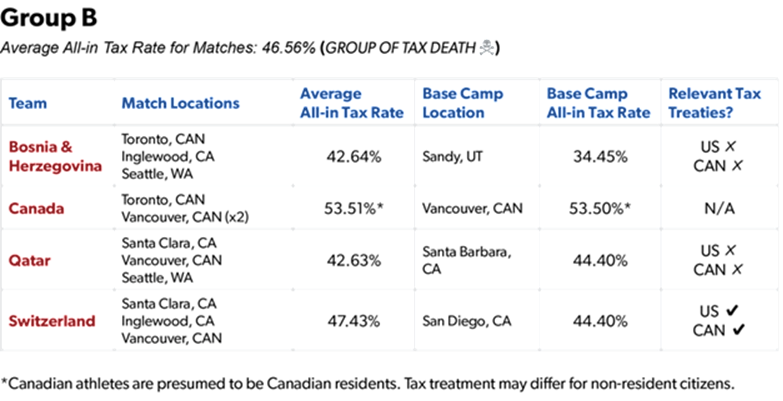
“Our unfortunate Group of Tax Death is Group B, which has the bad fortune to play almost all its matches in California or Canada. Bosnia & Herzegovina and Qatar at least get matches in (for now) tax-free Seattle, but neither country has tax treaties with the U.S. or Canada. Bosnia & Herzegovina will hopefully spend most of its time in Utah, which has a state tax rate that is about 1/3rd of California’s and 1/5th of British Columbia’s,” notes Wilford.
But the bottom line is that of all teams at this year’s World Cup, the unluckiest are New Zealand and Panama.
“New Zealand faces a higher jock tax rate at matches, though the Panamanian team’s decision to base out of Ontario will mean that the Panamanians will face the highest overall jock tax rate,” writes Wilford.
He also sums up the convergence of the international sports and U.S. taxes in his conclusion:
…
“Yet, while this has been a somewhat lighthearted exercise, the fact remains that navigating this intricate web of tax rules will be far more manageable for highly-paid soccer stars than it will be for underdog players earning modest salaries, as well as coaches and staffers for smaller teams. Greenback Tax Services estimates that the cost of hiring a professional to handle tax compliance for a player can be between $5,000 and $15,000. Kylian Mbappé [French star forward] and Erling Haaland [Norway’s Striking Viking and newly-minted Texas cowboy] may accidentally drop that amount of money and judge it not worth the effort to pick up, but for players and coaches on this year’s Cinderella teams, that is a significant expense.So, as you watch the rest of this year’s matches, remember that everyone is a winner. Especially the tax accountants.”
…
…
You also might find these items of interest:
- IOC’s cash-for-Olympians plan shouldn’t pose tax problem for many U.S. athletes
- Super Bowl LX’s super tax windfall for California is most extreme jock tax example
- $1 billion (and counting) in prediction market revenue is going untaxed, says gaming association
…
Advertisements
🌟 Search Amazon Tax Products 🌟
The text link above is an affiliate ad. If you click through and then buy a product, I receive a commission.

