
Photo by Pete Alexopoulos on Unsplash
…
Tax professionals can be money (and life!) savers at tax time. After you file, they also can help you deal with any Internal Revenue Service inquiries, as long as you officially authorize them to do so. Here are your third party tax representative options and how to invoke them.
…
Taxes have been part of my professional life, starting as a staffer on Capitol Hill and then returning to my journalism roots, for more than four decades. (Yes, I was a teen tax geek! OK, not true. But I’m still young at heart. 😉)
Throughout all these years and career transitions, I’ve worked to stay up to date on tax legislation, eventual laws, changes, and how this process affects all us regular taxpayers. That typically includes talking to tax pros.
Regular readers of the ol’ blog know that I often suggest they do the same. Since tax laws are complicated, and every individual’s financial, family, and tax circumstances are unique, a tax professional can help ensure you don’t miss or mess up tax breaks.
A tax pro’s role in representing you: When you do turn your taxes over to a pro, you probably expect your paid tax adviser to be the one the Internal Revenue Service will talk with if there ever is a question about your filings.
Even the IRS guarantees in its own Taxpayer Bill of Rights (#9) that we have the right to hire an authorized representative of our choice to represent us in dealings with the tax collector.
But that ability, known as third-party authorization, is not automatic.
Federal law mandates that the IRS safeguard your personal filing information. See the aforementioned Taxpayer Bill of Rights’ numbers 7 and 8 (Department of Government Efficiency prying and sharing of noncitizen filing data notwithstanding).
So, you must officially confirm that this other person — be it your tax professional, an attorney, a company official if the filing is for your business, a family member, or a trusted friend — can discuss your private tax specifics with the IRS before that can happen.
The IRS also has different types of third party authorizations, each with their own parameters and ability to work with the IRS to clarify any issue with your taxes.
Here’s a look at the four types of representative designations, along with the specific roles assigned to each, and how you formally grant them permission act on your tax behalf.
Power of Attorney (POA): This designation allows the named person to represent you in tax matters before the IRS. The representative must be an individual authorized to practice before the IRS. In most cases, this is an attorney, certified public accountant (CPA), or enrolled agents (EA).
Under special and limited circumstances, unenrolled return preparers, family members, employees, and students can be granted power of attorney to discuss your tax matters.
Once given your power of attorney for tax matters, the designated person can, among other things —
- Represent, advocate, negotiate, and sign on behalf of the taxpayer.
- Argue facts and the application of law.
- Receive tax information for the matters and tax years/periods specified by the taxpayer.
- Receive copies of IRS notices and communications.
You must authorize the granting of power of attorney with your signature, either with an actual pen-to-paper John Hancock or electronically.
If you go the e-route, certain tax professionals can submit a power of attorney authorization request to your online account. There you can review, electronically sign, and manage authorizations.
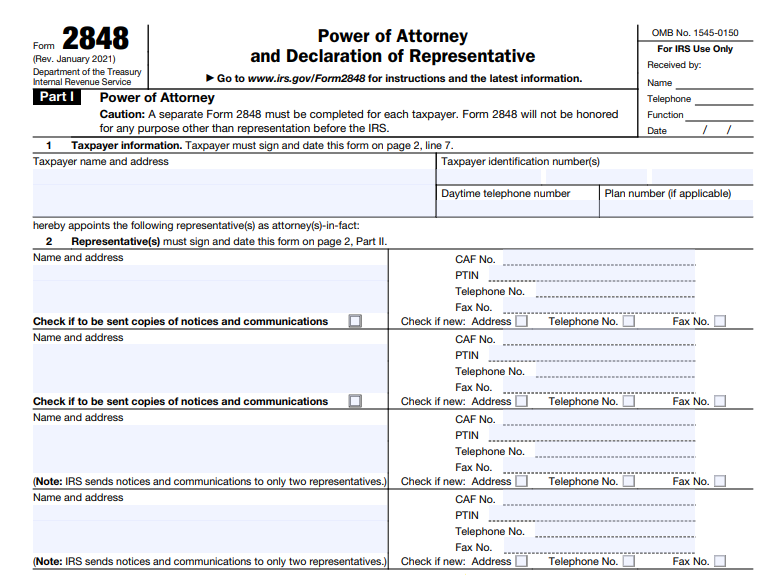
Or you can complete Form 2848, Power of Attorney and Declaration of Representative, (excerpt of the two-page form is shown below) yourself.
…
The IRS recommends that you submit it via your individual taxpayer account. If you haven’t gone totally tax electronic, you can send Form 2848 by fax or mail it. Details are in the form’s instructions.
Tax Information Authorization: With this representation option, you appoint anyone to review or receive your confidential federal tax information for the type of tax for a specified period.
With an official tax information authorization, your designee can —
- Review and/or receive your confidential information verbally or in writing for the tax matters and years/periods you specify.
- Disclose your tax information for a purpose other than resolving a tax matter. This is commonly used, for example, in income verification circumstances required by a lender or a background check.
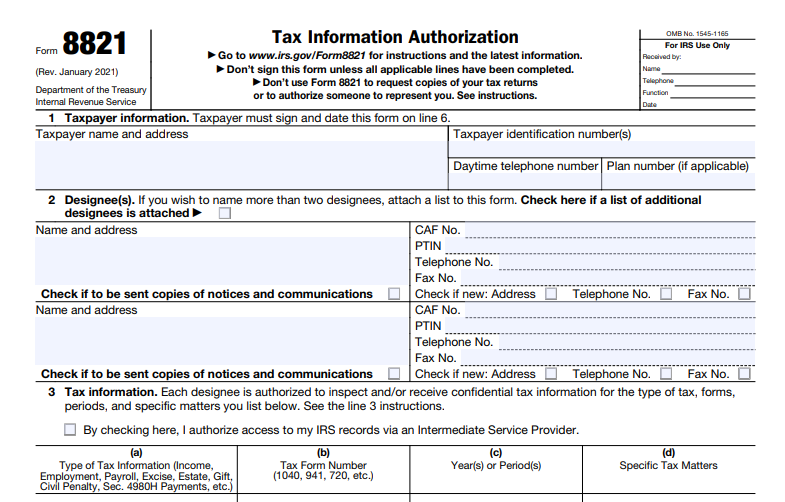
You can find more on tax information authorization on Form 8821, Tax Information Authorization, (excerpt shown below) and its instructions.
…
Third-Party Designee: This person is designated on your tax return to discuss that specific tax-year filing with the IRS. You can authorize your tax preparer, a friend, a family member, or any other person you choose as a third-party designee.
Your third-party designee also can —
- Give the IRS any information that is missing from your tax return.
- Call the IRS for information about the processing of your return or the status of your refund or payment(s).
- Receive copies of notices or transcripts related to your return, upon request.
- Respond to certain IRS notices about math errors, offsets, and return preparation.
Your third-party authorization is maintained in your tax record so that IRS assistance staff can verify your permission to speak with your representative about your private tax-related information.
Note, however, that third-party authority is limited to the specific tax form, time period of the return, and issues related to processing that specific return.
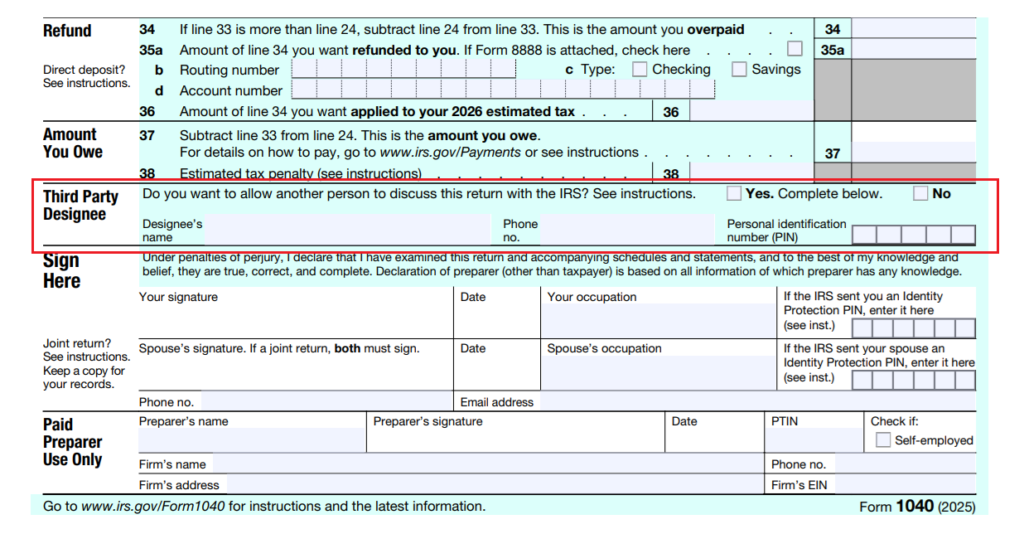
Authorizing a third party designee is simple. You just need to check the “yes” box in the Third Party Designee section on page 2 of Form 1040, highlighted on the excerpt below, and enter the requested information.
…
You can find more on the third party designee process for individual taxpayers on page 65 of the 1040’s instructions.
Business filers can authorize a third party designee on the IRS’ Forms 94X series and Forms 720, 1041, 1120, 2290 and CT-1.
Oral Disclosure: In this case, you verbally authorize the IRS to disclose your tax information to a person you bring into a phone call or meeting with the IRS about a specific tax issue.
This is a temporary situation. And your oral authorization of a tax representative is limited to the conversation in which you provide the authorization.
After you state that you wish to authorize oral disclosure of your tax information to a third party during the conversation with the IRS, the tax agency employees will confirm the following three things —
- Your identity and the identity of the third party,
- The issues or matters to discuss, and
- The tax return information we may disclose to allow the third party to assist you.
Your authorization for oral disclosure during the conversation is recorded on your tax account.
Unless you state otherwise, your oral authorization is automatically revoked once the conversation has ended. That means that the IRS cannot subsequently discuss your confidential tax return information with that person, or any third party, until you provide the agency with a new authorization.
If you think that continued communication with your designated third party will be necessary, consider granting that person another type of third party authorization. Where the person is not authorized to practice before the IRS, the typical step is to grant them the previously discussed Tax Information Authorization.
Revoking a third-party authorization: Taxes are intensely private. Sometimes your professional and personal relationships that involve them change. In these cases, you should consider revoking previously granted authorizations.
You can terminate any authorization at any time. That said, there still are some rules to note.
A tax power of attorney stays in place until the taxpayer revokes the authorization or the representative withdraws it.
Tax information authorization stays in effect until it is revoked by the taxpayer or the designee withdraws it.
A person’s third party designee status generally expires one year from the due date of the tax return, not counting extensions.
Oral disclosure, unless it’s stated otherwise, is automatically revoked once the conversation has ended. If the taxpayer wants additional oral disclosure exceeding the original request, a new authorization will be required.
So, get the professional (or other) tax help you want and need.
If you want your tax pro or other trusted person to have a more formal involvement in your dealings with the IRS, grant that individual the authority to do so.
And when such external involvement in your tax life is no longer needed, remove the access. You can also reinstate it if your tax situation changes.
You also might find these items of interest:
- Business taxpayers get new digital IRS options
- Improved IRS oversight of tax preparers could benefit taxpayers, says GAO report
- Married? Filing a joint return? Then make sure both spouses sign the 1040 or prepare to pay tax penalties
…
Advertisements
🌟 Search Amazon Tax Products 🌟
The text link above is an affiliate ad. If you click through and then buy a product, I receive a commission.