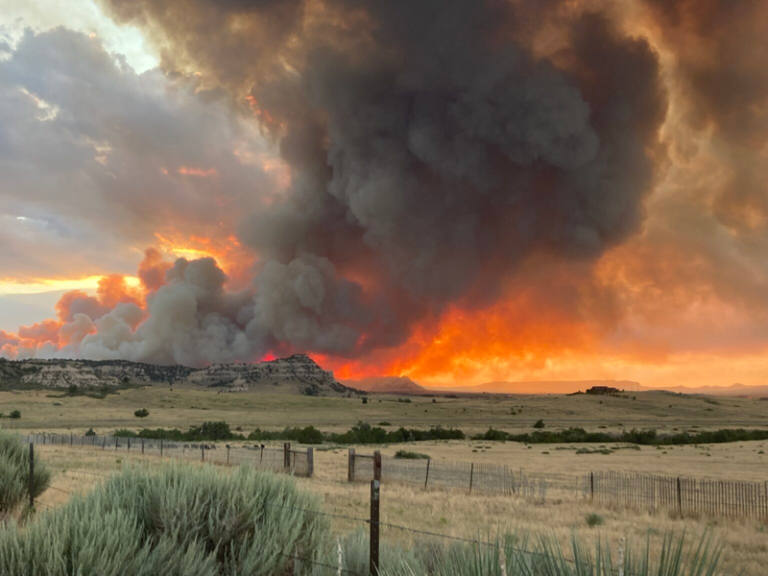
Record-setting blazes across Nebraska earlier this year burned more than 800,000 acres that once were grazing pastures, cropland, and locations of homes and farm structures. (Harvest Fire photo courtesy Nebraska State Patrol)
…
Wildfires and severe storms prompted the Internal Revenue Service last week to issue five separate disaster-related tax relief announcements for residents and business owners across Nebraska. They now have a new Feb. 1, 2027, filing deadline for various tax obligations.
…
Thank you Weather Gods for having the good sense to let Tropical Storm Dolly fade away last week. While the now-designated tropical wave’s remnants could produce heavy rains in the Caribbean, the immediate threat of a full-fledged storm or hurricane have lessened. Let’s hope it stays that way. Nobody wants a storm with that name wreaking havoc so soon after we lost the beloved Dolly Parton.
But, as I noted before all the distressing Dolly revelations, severe weather unrelated to the current hurricane season has done (and continues to do) substantial damage. And, as promised in that post, I’m trying to be more current on reporting tax relief for areas hit hard enough for either state officials or the Federal Emergency Management Agency (FEMA) to issue major disaster declarations.
That posting pledge takes us to Nebraska. Individuals and businesses that sustained major damage from severe storms and wildfires across the Cornhusker State are the latest recipients of such announcements and subsequent tax relief.
Series of disasters with a Feb. 1, 2027, tax deadline: The disasters occurred from mid-March through early June. So, the IRS relief spans several areas and time frames.
But they all share a common Feb. 1, 2027, final filing and payment deadline for some tax obligations.
And since the state-declared disaster time frames are staggered, the specific tax relief and types of filings and payments that qualify differ. And some other tax tasks are delayed, but must be completed before next February.
The five IRS tax relief announcements issued Aug. 25 for Nebraska taxpayers are listed below in the order released by the tax agency. I’ve noted the covered areas, as well as the date and type of disaster, that prompted the IRS action.
If you are in one of the regions, you can find details in the IRS announcements that are linked in each of the declaration’s numbered headings.
- Wildfires that began on March 12. Relief granted to Nebraska individuals and households that reside or have a business in Morrill, Garden, Arthur, Keith, Grant, Lincoln, Dawson, Frontier, Saunders, and Red Willow counties.
The Feb. 1, 2027, deadline applies to individual income tax returns and payments normally due on or after March 12, 2026. It also applies to affected quarterly payroll and certain excise tax returns.
….. - Wildfires that began on April 22. Relief granted for those affected by the Pressey Fire in central Nebraska that began on April 22, 2026. It applies to individuals and households that reside or have a business in Custer County.
The Feb. 1, 2027, deadline applies to individuals who had a valid extension to file their 2025 individual income tax return. Note that tax payments related to these 2025 returns were due on April 15, 2026, so those payments are not eligible for this relief. Penalties and interest will continue to accrue on unpaid 2025 tax due.
The Feb. 1, 2027, deadline also applies to certain payroll and excise taxes, as well as affected quarterly payroll and certain excise tax returns.
…
- Severe storms that began on May 15. Relief granted to individuals and households that reside or have a business in Buffalo, Fillmore, Gage, Jefferson, Nemaha, Richardson, Thayer, Thurston, and Howard counties.
The Feb. 1, 2027, deadline applies to business and individuals taxpayers who had a valid extension to file their 2025 individual income tax return. As with the Pressey Fire relief, because tax payments related to these 2025 returns were due on April 15, 2026, those payments are not eligible for the later payment granted the filings themselves.
The Feb. 1, 2027, deadline also applies to certain payroll and excise taxes, as well as affected quarterly payroll and certain excise tax returns.
… - Wildfires that began on May 16. Relief granted to individuals and households that reside or have a business in Dawes County. The Feb. 1, 2027, deadline applies to individual income tax returns and payments normally due on or after May 16, 2026. The Feb. 1, 2027, deadline also applies to affected quarterly payroll and certain excise tax returns.
… - Wildfires that began on June 9. Relief granted to individuals and households that reside or have business in Sioux County. The Feb. 1, 2027, deadline applies to individual income tax returns and payments normally due on or after June 9, 2026. The Feb. 1, 2027, deadline also applies to affected quarterly payroll and certain excise tax returns.
…
Additional general disaster relief for all areas: In each announcement, the IRS notes that the same tax relief will be available to any other counties added later to the various disaster areas. You can find that updated information on IRS.gov’s tax relief in disaster situations.
Also, there is no need for affected taxpayers to take any additional steps to get the tax relief provided in connection with their disaster. The IRS automatically identifies taxpayers located in the covered disaster area and applies filing and payment relief.
However, affected taxpayers who reside or have a business located outside a covered disaster area, but have a tax preparer or records in a disaster locale, should call the IRS Special Services toll-free at (866) 562-5227 to request the same tax relief.
When filing anything affected by IRS-granted disaster relief, note the specific declaration number on the filing. Those are noted in each of the linked IRS announcements. The disaster declaration number also should be used to expedite requests for previously-filed tax returns or tax transcripts you need in connection with your disaster tax filings.
And if you are in a disaster tax relief area but get a late-filing or late-payment penalty notice from the IRS that has an original filing, payment or deposit due date that falls within these various Nebraska tax relief periods, call the telephone number on the notice to have the penalty abated.
Claiming disaster losses as a tax deduction: Finally, don’t forget that as a taxpayer in a major disaster area you might be able to claim some of losses as a tax deduction.
You also have some timing leeway here.
You have the option of claiming disaster-related casualty losses on your federal income tax return for either the year in which the event occurred, or the prior year. You also have extra time — up to six months after the due date of the taxpayer’s federal income tax return for the disaster year (without regard to any extension of time to file) — to make the loss claim tax year election.
You can read more about this deduction option in my post discussing considerations in making a major disaster tax claim. Also check out IRS Publication 547 for details. And, of course, you can talk with your tax adviser about your disaster loss tax options.
…
Advertisements
🌟 Search Amazon Tax Products 🌟
The text link above is an affiliate ad. If you click through and then buy a product, I receive a commission.