
…
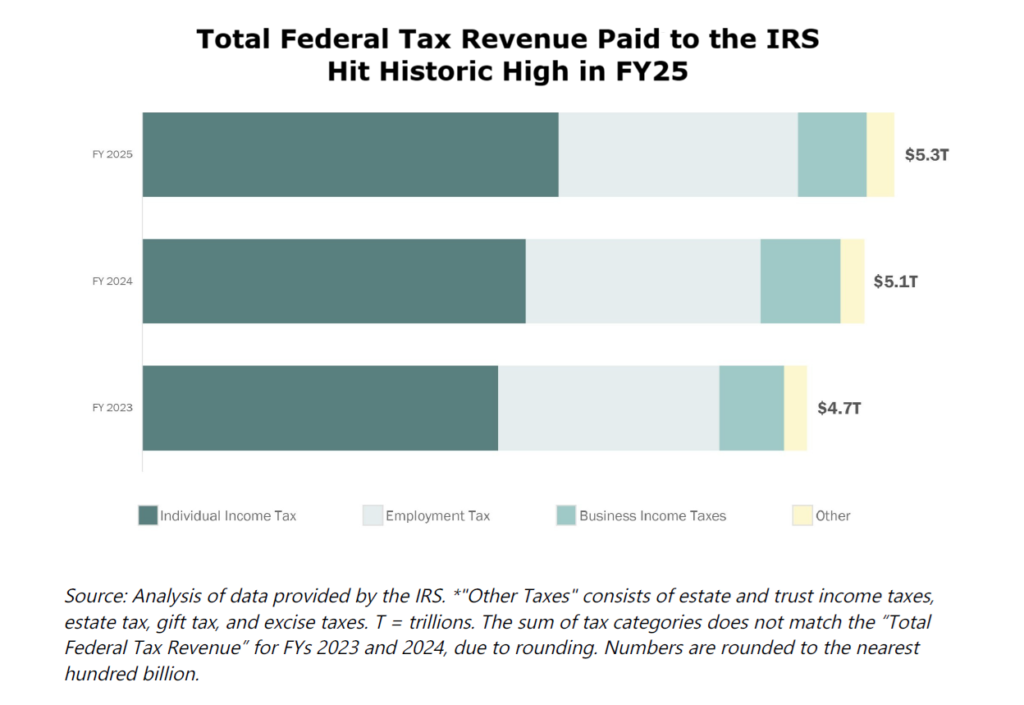
Despite challenges posed by leadership issues, funding cuts, and reductions in staff, the Internal Revenue Service received $5.3 trillion in revenue in fiscal year (FY) 2025.
That amount paid during the Oct. 1, 2024, through Sept. 30, 2025, time frame, was roughly $213 billion (4.2 percent) more than in FY 2024 and $619 billion (13.2 percent) more than in FY 2023.
The trillions in FY 2025 revenue also was the most ever paid by taxpayers, without adjusting for inflation, according to a Treasury Inspector General for Tax Administration report released today.
Successful, but reduced, enforcement payments: The TIGTA report reviewed, pers its official “Trends in Compliance Activities Through Fiscal Year 2025” title, various tax-collecting activities.
It noted that $93.8 billion of the record fiscal 2025 collection total came from enforcement revenue.
That amount, however, was down from the record $98.7 billion enforcement brought in during FY 2024. TIGTA attributed the drop in these collections to a 35 percent decline in examination, or what we taxpayers typically refer to as audit, revenue.
Tax Gap underscores compliance efforts: In addition to collecting money to fund Uncle Sam’s ongoing operations, IRS collections also are needed to replace lost revenue.
Some of those losses are in the growing Tax Gap, which underscores the importance of IRS efforts to increase tax compliance.
The Tax Gap is the amount of tax that is legally owed, but which the IRS has not been able to collect for a variety of reasons. The most recent Tax Gap projection was $696 billion, made by the IRS for tax year 2022.
That estimated shortfall is comprised of three components: $63 billion from taxpayers who do not file; $539 billion from those who file but underreport earnings; and $94 billion in taxpayer underpayments.
If the latest IRS annual amount of nearly $700 billion in uncollected tax is calculated cumulatively over a decade, the gross Tax Gap approaches $7 trillion, according to The Budget Lab, Yale University’s non-partisan policy research center.
So, this latest report of record revenue paid to the IRS is a solid step in reducing the Tax Gap. But perhaps not for long.
Revenue warning signs ahead: The IRS bumped up staffing substantially in in FY 2023 and 2024. However, the agency lost approximately 27 percent of its Examination and Collection staff from FY 2024 to FY 2025.
TIGTA notes that these personnel losses influenced fiscal 2025’s numbers. It also expects the staffing challenge to reflect poorly on future IRS activity.
Or, in the report’s words, “the downstream effects of these reductions are likely to become more apparent over time.”
Continuing IRS budget battles: Then there are the agency’s operating dollars.
While the IRS’ overall annual appropriation remained flat at $12.3 billion from FY 2023 through FY 2025, the IRS enforcement budget was supplemented in recent years by $3.8 billion from the Biden administration’s Inflation Reduction Act (IRA).
But by Dec. 31, 2025, the IRS had exhausted this supplemental tax enforcement funding.
Still, with the federal deficit continuing to balloon, let’s take any good revenue news we can get.
Tax notices increased: A key tax collection method is via tax notices. They point out filing errors and tax shortfalls and encourage payment, in full or via payment plans, so that taxpayers can avoid more invasive collection methods.
In FY 2023, TIGTA notes that the IRS did not send out any notices to nonfilers. But there was a good reason. COVID-19 prompted private sector and government shutdowns, including of much of the IRS, forcing the agency to recalibrate operations.
By fiscal 2024, more normal activity had resumed. That fiscal year, the IRS sent nearly 1.7 million notices to individual nonfilers for cases primarily involving the 2020 through 2022 tax years. During that two-year height of the COVID pandemic, the IRS paused issuance of nonfiler notices intermittently.
And by FY 2025, the report notes the IRS sent approximately 3.2 million notices to individual nonfilers. Most of there were in connection with tax year 2023 returns
In February 2024, the IRS resumed the return delinquency notice process, as well as announced a new effort aimed at high-income nonfilers.
Audit and collection data updates: The TIGTA report also reviewed audit statistics.
Examination (audit) revenues increased 41 percent from FY 2023 to 2024, before declining 35 percent in FY 2025, coinciding with increased staffing followed by workforce reductions.
In FY 2024 to 2025, the number of IRS examinations (audits) started for individual returns also declined, this time by 30 percent. That included a 27 percent decline for taxpayers with incomes over $400,000.
The report did not mention how the drop in audits of $400,000+ taxpayers might or might not be related to 2024’s new higher earners effort.
As for collection efforts, revenue here increased 17 percent from FY 2023 to FY 2025. This helped offset declines in other enforcement revenue categories, primarily due to resumed automated collection notices.
Finally, since the report provided information only, TIGTA made no recommendations. IRS officials reviewed it before it was made public, and agreed with the report’s facts and conclusions.
Updated Sept. 1, 2026, to add Tax Gap data from Yale’s The Budget Lab.
…
You also might find these items of interest:
- Why the rich pay at a lower tax rate than the rest of us
- Tax whistleblowers have helped IRS recover more than $8 billion
- AI’s potential to increase IRS audits raises expectations and fears
…
Advertisements
🌟 Search Amazon Tax Products 🌟
The text link above is an affiliate ad. If you click through and then buy a product, I receive a commission.