


These snow-obscured signs aren’t much help, but the ol’ blog, basking in unseasonably warm January temperatures here in Central Texas, has some clearer tax guideposts to help you welcome 2026 and prepare for the new tax season. (Photo by Christina & Peter)
Happy New Year! I know. We’re well past Jan. 1. But if you are like me, last Friday was spend recovering from ringing in 2026.
Not that the hubby and I drank too much. Rather, we ate too many holiday sweets that friends and family were wonderful enough to share.
Then there was the weekend.
So, the start of this first full week of January 2026 is the perfect time to once again say Happy New Year! And I’ll go a step further, wishing all the readers of the ol’ blog a Happy New Tax Year!
Tax challenges for all ahead: 2026 should be an interesting one, especially when it comes to taxes.
The Internal Revenue Service is facing challenges. Although it has a CEO, there’s no official IRS Commissioner. And the tax agency’s ranks have been slashed, leaving the small staff to deal with the many retroactive 2025 tax law changes included in last year’s Republican tax reform bill, the One Big Beautiful Bill Act (OBBBA).
There are ones that will affect our 2025 returns, and more to consider as we work on this year’s tax-saving strategies. That means Uncle Sam’s tax collector is sure to be swamped with questions from taxpayers and tax professionals.
Pondering what’s ahead for both IRS agents and taxpayers this year has me sort of wishing I had some of the adult beverages that many used to toast Dec. 31’s stroke of midnight. But since it’s Monday, and the start of a work week, I’ll stick with my coffee to energize me as I look at four tax moves to consider making this January 2026.
Everyone’s tax situation is different, but I hope at least a couple of them can help you get this brand spanking new year off to a good tax start.
1. Get ready to file: Millions of taxpayers already are on top of this. They are expecting larger than usual tax refunds, thanks in large part to OBBBA tax breaks that apply to 2025 tax year returns.
In addition, the Internal Revenue Service didn’t adjust payroll withholding calculations to account for these tax benefits, so lots of salaried workers had more federal taxes taken from their paychecks after the OBBBA became law on July 4.
You’ll need some official paperwork to determine just how much of a refund you’ll get when you file your Form 1040 this year. So be on the lookout for tax documents, such as your W-2 and various 1099 forms.
Also have your and your family members’ Social Security numbers handy. You’ll need them to claim a variety of tax deductions and credits.
If you don’t already have a bank account, look into opening one now. The IRS, per Donald Trump’s Executive Order 14247 issued last March, is phasing out paper tax refund checks. To get your refund more quickly, and securely, have the IRS directly deposit it to your existing, or new, bank account.
And speaking of accounts, consider opening an online taxpayer account at IRS.gov. There you can access your personal tax information, including tax records like recently filed returns. You also can check the status of your refund, view digital notices from the IRS, and, if you find you owe Uncle Sam, make secure online tax payments or set up a payment plan if your tax bill is surprisingly large.
I know it’s frustrating to have to wait when you’re expecting a tax refund, but you shouldn’t send your 1040 to the IRS until you have all your necessary, official, and correct tax records. If you enter the wrong amount based on your own rough estimate, the IRS will hold your return processing — and refund issuance — until the differing documentation data is reconciled.
2. Note your deduction amount: The Tax Cuts and Jobs Act (TCJA) of 2017 dramatically increased the standard deduction amount. Since its enactment, more of us filers have opted to use the standard amount, which is determined by our filing status, rather than itemize.
Last year’s OBBBA reinforced that standard claim trend by also bumping up the amounts for the 2025 tax year. They now are —
- $15,750 for unmarried taxpayers and married partners filing separate returns;
- $23,625 for head of household filers; and
- $31,500 for married couples who file a joint Form 1040, as well as surviving spouses.
However, changes in the latest tax reform bill also make claiming itemized tax deductions on Form 1040 Schedule A more appealing to some filers. The most notable one is the increase of the state and local taxes (SALT) deduction cap from $10,000 to $40,000 for the 2025. This temporary SALT change will increase the new $40,000 limit by 1 percent yearly through 2029; the SALT cap reverts to $10,000 in 2030.
Most filers who will use the 2025 SALT change, as well as take advantage of last year’s more beneficial charitable itemized claims, already have taken steps to file Schedule A. But you need to now make sure you have all the backup data to support your itemized entries.
Finally, if you’re a taxpayer age 65 or older, be sure to check out the OBBBA’s new senior bonus. Depending on your income, you could claim an added $6,000 deduction. If you’re married and your spouse also is at least 65, that’s a six grand maximum tax break for each of you. The amount, however, starts phasing down if your modified adjusted gross income (MAGI) is more than $75,000 as a single filer or $150,000 for married couples filing jointly.
But the good news is that regardless of how much senior bonus you can claim, it’s available to all qualifying filers regardless of whether they take the standard deduction or itemize.
3. Pay your estimated taxes: This third January 2026 tax task is a far less welcome one. If you pay estimated tax, the prior year’s final payment is due Jan. 15.
These four extra payments — due the 15th of April, June, September, and January of the next year — cover tax due on earnings not generally subject to withholding. This includes such things as investment proceeds, gambling and prize winnings, and income from gig jobs.
You can make this final (and all) estimated tax payments electronically or, if you choose the snail mail route, by submitting the appropriate 1040-ES voucher (pictured below).
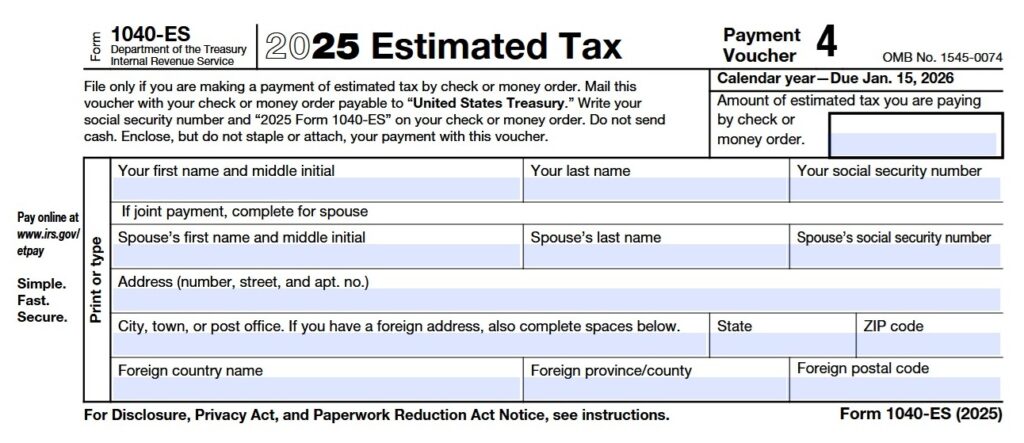
The full estimated tax packet includes mailing addresses in the instructions. And don’t panic if you plan to mail your fourth payment. It doesn’t have to arrive at the IRS by the due date. The IRS considers it timely paid as long as the envelope has a Jan. 15 postmark.
But be careful. A recent U.S. Postal Service change means things are no longer as simple as dropping your IRS-addressed envelope into a mail slot. Effective Dec. 24, 2025, the postal service is now applying most postmarks at processing facilities, not at local branch offices, so the date stamped on your envelope could be later than when you dropped it into the mailbox or handed it to the postal clerk.
You actually can skip this final estimated payment if you’re sure you’ll get your 2025 tax return filed and, if you owe, will pay any due taxes by Jan. 31. Don’t take this informal extension lightly. Good intentions don’t count.
If you miss the January estimated tax payment and then don’t file your annual return by the end of the month, the IRS will penalize you for not paying your estimated taxes on time.
4. Adjust your paycheck withholding: Finally, since we started off talking about how so many taxpayers could see larger refunds this year, I feel compelled to offer my counter argument to this practice.
I know, a lot of people view withholding too much tax as an easy forced savings account. But the Bank of Uncle Sam does not pay any interest for holding your — and I emphasize your — money for a year or more, depending on when you file and the IRS gets around to processing your return.
Also, if there’s an issue, either with something on your tax return or at the IRS, your refund could be delayed. Some tax watchers are warning that such delays could happen this filing season.
Congressional budget cuts and Department of Government Efficiency (DOGE) decisions are forcing the tax agency to operate with fewer personnel than in past filing seasons. And these remaining IRS agents must deal with the previously noted myriad OBBBA tax law changes, as well as with the taxpayers who have questions about the new provisions.
So, rather than wait, possibly longer than you want, for your refund, get your money in real time. You’ll see it pay period when you adjust the amount taken of federal (and state) tax taken out of each paycheck. Your goal is to have your withholding amount to be as close as possible to your final tax return liability.
The change could mean that instead of waiting for one lump sum from the IRS due to over withholding, your refund will be parceled out in each paycheck. That’s a little extra cash every payday to cover bills or treat yourself or save for emergencies or retirement.
More-accurate withholding also helps if end up owing on Tax Day. If you’ve been under withholding, having a bit more incrementally taken out of your paychecks will mean you won’t have to worry about how to pay an alarmingly big federal tax bill in April.
The IRS’ online Tax Withholding Estimator, available in English and Spanish, can help you determine the proper withholding amount. Then use the estimator’s results to complete a new W-4 to give to your employer.
Okay, I know that these four January tax moves might seem a bit daunting as we’re trying to get our footing in this new year.
But if you can make time this month to take care of the ones that apply to your tax situation, 2026 will probably be a lot less frustrating, at least from the tax point of view.

