

Bad math? Numerical dyslexia? Politics? Whatever the answer, a new Treasury Inspector General for Tax Administration report says the Internal Revenue Service overestimated the fiscal year 2025 cost of its now-defunct free tax prep and filing option by $45 million.
The Internal Revenue Service created Direct File to provide taxpayers a free way to prepare and e-file their annual tax returns without having to pay a commercial middleman.
But opponents argued the costs to the U.S. Treasury were too much. That was a key factor in ending Direct File just as the program was expanding.
Now, a new tax watchdog report says the IRS’ estimate that Direct File would cost $61.2 million for fiscal year 2025 was grossly exaggerated. In fact, according to the Treasury Inspector General for Tax Administration (TIGTA), the tally for the agency’s web-based tax filing service as of May 2025 was $16.2 million.
Numerical dyslexia? Bad math? A political agenda? Whatever the answer, those two amounts are this weekend’s By the Numbers figures.
In addition, the TIGTA Direct File report also earns Saturday Shout Out recognition.
Dollars doomed Direct File: The amount needed to operate Direct File were “significantly less than estimated,” noted TIGTA’s March 19 report, because the IRS overestimated the number of taxpayers who would use Direct File and the number of IRS personnel needed to help them.
The IRS also did not use some engineering and design contracts because the program was halted.
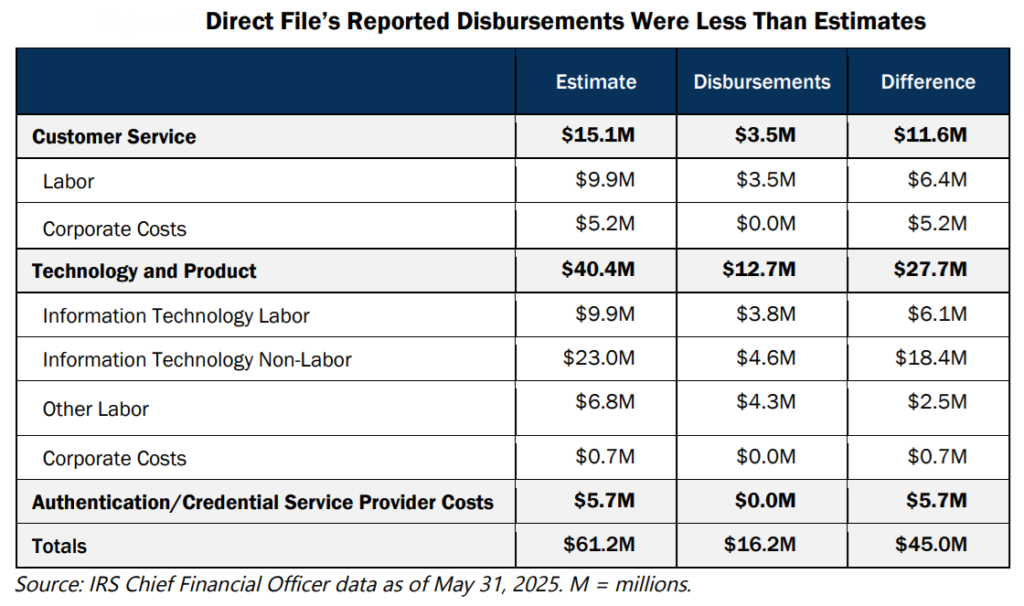
“However, the IRS’s reported cost for Fiscal Year 2025 continued to exclude the costs from all IRS support functions,” noted TIGTA.
“For example, Direct File did not include costs for employees detailed to the IRS by another federal agency to help develop and pilot Direct File, costs for other IRS functions’ employees who supported the program, and authentication costs.”
Political tax software fight: In addition to costs, the Direct File faceoff also reflected lawmakers’ different tax policy positions.
Republicans had argued that Direct File was wasteful and represented government overreach. A study of the IRS-operated tax preparation and filing option that was mandated by the GOP’s One Big Beautiful Bill Act found that Direct File cost about $138 per return.
Direct File’s GOP opponents also cited the program’s low participation, even after it was expanded from 12 states in its 2024 filing season pilot year to 25 states in 2025.
“During the 2025 Filing Season, the IRS estimated that 32 million taxpayers would be eligible for Direct File,” according to the TIGTA report. “However, only 751,000 taxpayers registered to use it, 59% of which didn’t end up using it to submit a tax return. IRS attributed lower than expected usage to confusion about availability and a lack of outreach.”
Democrats who pushed for an IRS-operated filing program and finally saw it initiated during the Biden administration countered that Direct File was a positive move from the taxpayer service perspective.
They pointed to lower- and middle-income taxpayers, for whom Direct File was originally created, as being able to avoid costly commercial filing programs. They also cited the satisfaction with Direct File by the taxpayers who did use it.
As for the relatively minuscule number of 751,000 registered Direct File users in 2025, TIGTA noted that number represented a 78 percent increase from the 423,000 registered taxpayers during the 2024 filing season.
And a Government Accountability Office report issued in December 2024 found that Direct File received top scores from 90 percent of the taxpayers who used it.
Improvements made in second year: Direct File supporters also argued that the low participation numbers was not unexpected. All new endeavors, whether public or private, are cautious in early stages. And since Direct File immediately involved individuals’ money, the IRS needed to roll out the program judiciously to gauge how it worked and limit the scope of initial problems.
In the second year, they noted that Direct File not only expanded to a larger pool of taxpayers, but also expanded filing situations it was able to handle.
The IRS also made progress reducing the number of rejected Direct File submitted returns. Part of this improvement was thanks to the agency’s ability to import some information returns during the 2025 filing season to reduce human error.
TIGTA’s report found opportunities for expanding IRS importation of relevant filing data, as well as tax forms for secondary filers, corrected tax forms, and additional tax forms through individual online taxpayer accounts.
But, such expansion is moot. For now.
If you’re still looking for free or low-cost tax return prep and filing options, check out the possibilities in 5 free tax prep and filing options, and a move to restore a sixth. A popular one is the current public-private partnership Free File.

