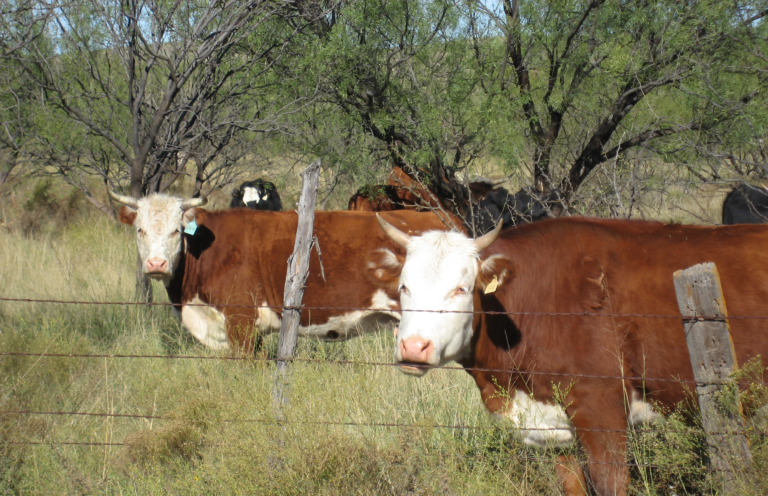
These cattle chilling out in the Big Bend region of West Texas don’t appear worried about much. Their owners, however, have a lot of concerns, including the extremely dry conditions that could hurt the profitability of their agricultural endeavors. The Internal Revenue Service is offering some ranchers and farmers across the country (and beyond) special drought-related tax relief. (Photo by Kay Bell)
…
We got rain today! OK, it was a brief shower. Not even enough to register in our backyard rain gauge. But it did slightly dampen our poor, brittle grass.
As a suburban homeowner, a ragged yard is mostly an annoyance. But for folks whose livelihoods depend on Mother Nature offering a climatological hand now and then, the nationwide drought is posing real problems.
The U.S. agricultural sector is struggling this year. Severe drought and record heat has led to crop failures, livestock stress, feed shortages, and an overall increase in operating costs.
Farmers have had to abandon fields. Ranchers have had sell their livestock sooner than they expected and at lower prices. Many have filed for bankruptcy.
But now, some of the ag operations still hanging on are getting a bit of help from Uncle Sam. The Internal Revenue Service has issued guidance on how farmers and ranchers who sold or exchanged livestock because of drought conditions can get an extension of tax relief for those transactions.
Specifically, affected farmers and ranchers may take more time to replace their livestock. This delay also allows them to defer the due tax on any gains from the forced sales or exchanges.
Easing livestock sale tax costs: The livestock sales triggered potential capital gains taxes. But farmers and ranchers sold the animals not because it was the optimal business decision.
They were forced to sell because keeping the livestock during drought conditions worsened their already dire financial circumstances. And is often the case with taxes, new problems arose.
The drought-related forced sales compounded the sellers’ fiscal worries by adding the capital gains taxes to the mix.
Generally, tax law requires agriculture businesses to replace sold livestock within a four-year period, instead of the usual two-year period. That time frame, however, might not be workable for some farms and ranches.
The IRS recognized the ag sector’s dilemma, and decided to provide more leeway in replacing the livestock and paying the tax. Notice 2026-54 now gives eligible farmers and ranchers have until the end of their first tax year after the first drought-free year after the four-year replacement period to replace the sold or exchanged livestock.
That means that eligible farmers and ranchers whose drought-sale replacement period was scheduled to expire at the end of 2026 will have until the end of their next tax year to replace the sold or exchanged livestock.
“Large swaths of the United States continue to experience drought conditions, distressing hard-working American farmers and ranchers,” said IRS Chief Executive Officer Frank J. Bisignano in announcing the relief on Sept. 15. “By extending relief for those who sell or exchange livestock, the IRS is providing much needed support to those who feed our nation.”
Qualifying locations: The extension option applies to ag businesses located in a region listed as suffering exceptional, extreme or severe drought conditions during any week between Sept. 1, 2025, and Aug. 31, 2026.
The qualifying drought determination is made by the University of Nebraska’s National Drought Mitigation Center. Right now, that applies to areas of 49 states and the District of Columbia. I know you’re wondering. The only state not making the drought list is Alaska.
…
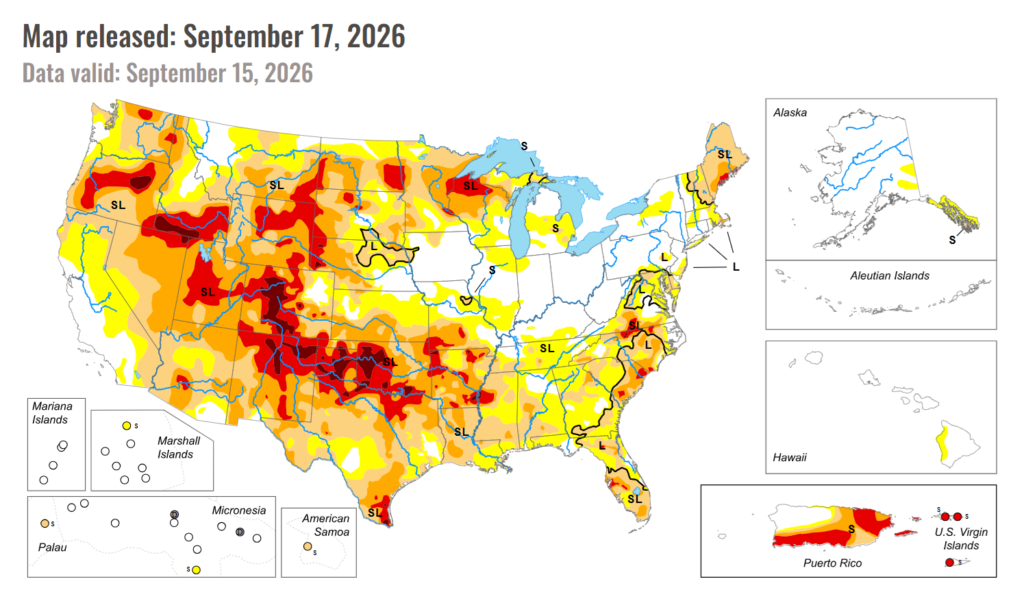
Latest drought conditions in the United States. Map via U.S. Drought Monitor. United States and Puerto Rico Map Author: David Mocko, NASA/GSFC/SSAI; Pacific Islands and Virgin Islands Author: Lindsay Johnson, National Drought Mitigation Center
…
The same relief also is afforded to eligible ag operations in the U.S. territories of Puerto Rico and the U.S. Virgin Islands, as well as to those in the Freely Associated States of Republic of the Marshall Islands and Federated States of Micronesia.
The specific eligible counties or other jurisdictions are listed, starting on page 4, in the IRS’ Notice of Extension of Replacement Period for Livestock Sold on Account of Drought.
Eligible operations: The IRS also set some limits on the types of agriculture operations eligible for the relief.
The tax relief generally applies to capital gains realized from sales or exchanges of livestock held for draft, dairy or breeding purposes. Sales of other livestock, such as those raised for slaughter or held for sporting purposes, and sales of poultry do not qualify.
Eligible farmers and ranchers must show that drought prompted the sales or exchanges. They also must provide proof that their area received a federal drought designation.
And if the drought doesn’t loosen its grip, the IRS is authorized to further extend this just-announced replacement period.
You can find more information on reporting drought sales and other farm-related tax issues can be found in IRS Publication 225, Farmer’s Tax Guide.
You also might find these items of interest:
- Happy Earth Day to goat farmer Donald J. Trump
- Tom Cruise plays part of Colorado rancher to net minimal property tax bill
- Artificial grass tax evasion scheme ends in real prison time for company owner
…
Advertisements
🌟 Search Amazon Tax Products 🌟
The text link above is an affiliate ad. If you click through and then buy a product, I receive a commission.