


Most of us are salaried employees. But as economic times have changed, more workers and companies have turned to independent contracting to get jobs done. The difference matters for lots of reasons, for both workers and those hiring. That includes tax responsibilities.
…
Happy Dolly Day! It’s not an official holiday, federal or state. But Sept. 25, or 9/25, has been informally designated as the day we celebrate Dolly Parton.
We lost the composer and singer of “9 to 5,” the great working world musical ode, so this Dolly Day is a bit sadder. But I suspect Dolly, in her joyous, life-embracing, and justice-seeking way, wouldn’t want us to dwell on how much we miss her.
So, I plug along today, with her song playing in the background as I compose this overview of the differences between employees and contract workers. And yes, there are tax, not just performance, distinctions between the two.
Personal and business preferences: The independent contractor life could be for you if you’re tired of having a boss constantly looking over your shoulder and on your back about job specifics. You have the freedom to take as many or as few assignments as you want or need. In most cases, there’s no commuting.
But you don’t have long-term employment security or workplace benefits, such as medical insurance and retirement plans. And, of course, you have a lot more record keeping and tax obligations to meet.
Companies also like contractors, usually for bottom-line reasons.
Even when a contractor is paid the same as a full-time employee, the independent workers tend to cost businesses less because they don’t have to pony up for the aforementioned benefits packages.
As far as taxes go, businesses don’t have to pay unemployment insurance costs, federal and state, for contractors. The companies also are off the hook for collecting the contracted workers’ payroll taxes that go toward Social Security and Medicare, meaning they don’t have to hand over the corporate component of those taxes.
Determining work role: There’s general agreement between workers and employers over when a person is a contractor instead of an employee. Much of it depends on the control factor.
When you are an employee, your boss has more immediate input into and regulation of how a job is done. Contractors, however, typically have more leeway over how and when a job is done, as long as the final deadline is met.
Uncle Sam, however, likes things to be more precise.
The Department of Labor (DoL) has tests to determine whether a worker should be classified as an employee or contractor. Below is a Labor Department side-by-side graphic highlighting the key differences between employees and contractors.
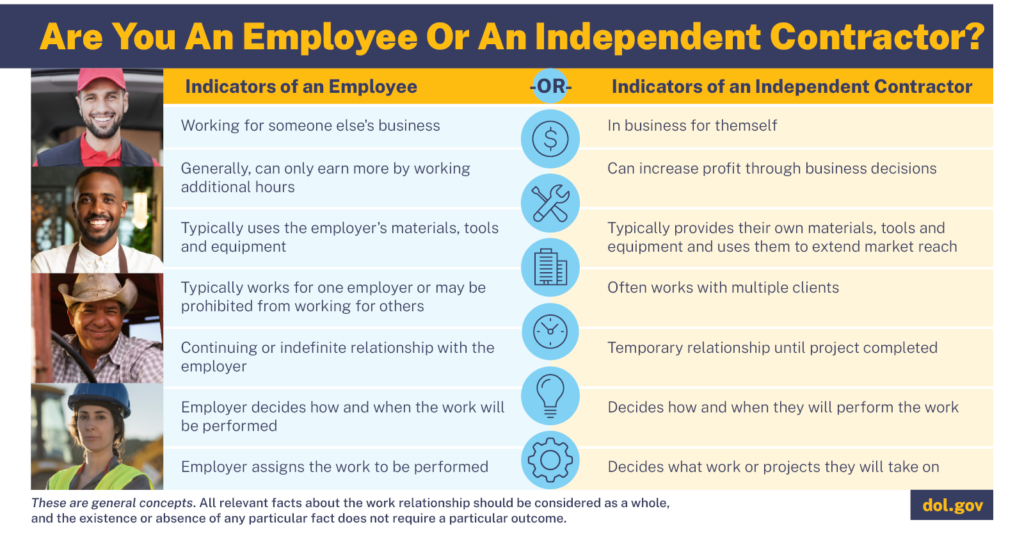
The Labor Department also has an online Small Entity Compliance Guide. It includes an overview of employee or independent contractor classification under the Fair Labor Standards Act (FLSA).
It also breaks out the six factors of the Economic Reality Test, which it uses to analyze if a worker is an independent contractor or employee under the FLSA. They are —
- Opportunity for Profit or Loss Depending on Managerial Skill
- Investments by the Worker and the Potential Employer
- Degree of Permanence of the Work Relationship
- Nature and Degree of Control
- Extent to Which the Work Performed is an Integral Part of the Potential Employer’s Business
- Skill and Initiative
Employee vs. contractor tax overview: The IRS, as we all know, also likes to follow frameworks. In the employment area, the tax agency uses the FSLA and DoL breakout in defining the tax responsibilities of employers, employees, and contractors.
You can find the IRS guide on how it determines whether a person is providing a service as an employee or an independent contractor at the IRS.gov independent contractor (self-employed) or employee web page.
Again, the control factor is key. The IRS wants to know who is primarily in charge, the company or the worker doing the job? In determining that, the federal tax collector says “all information that provides evidence of the degree of control and independence must be considered.”
This basically is the formal way of saying all work situation are different and the facts and circumstances (yeah, that favorite IRS phrase) of each work situation must be taken into account.
The facts that provide evidence of the degree of control and independence fall into three key categories, discussed below.
Behavioral control: The key question is whether the company controls or has the right to control what the worker does and how the worker does his or her job.
Note that a business doesn’t have to actually direct or control the way the work is done. It simply must have the right to direct and control the work.
Behavioral control factors fall into the categories of —
- Type of instructions given. This includes direction on when, where and how to work. More specific instruction covers what tools or equipment to use, where to purchase supplies, the order or sequence to follow in doing the job and if additional help is needed, what workers to hire
- Degree of instruction. Generally, the more detailed the instructions, the more control the business exercises over the worker. More detailed instructions indicate that the worker is an employee. Less detailed instructions reflect less control, indicating that the worker is more likely an independent contractor.
- Evaluation systems. If an evaluation system measures the details of how the work is performed, then these factors would point to an employee. If the evaluation system measures just the end result, then this can point to either an independent contractor or an employee.
- Training. If the business provides the worker with training on how to do the job, this indicates that the business wants the job done in a particular way. This is strong evidence that the worker is an employee. Periodic or on-going training about procedures and methods is even stronger evidence of an employer-employee relationship.
Financial control: Financial control refers to facts that show whether or not the business has the right to control the economic aspects of the worker’s job. This includes things like how worker is paid, whether expenses are reimbursed, who provides tools/supplies, etc.
Among the financial control factors are —
- Significant investment. Typically, an independent contractor has a significant investment in the equipment he or she uses in working for someone else. There are no precise dollar limits that must be met in order to be deemed a significant investment. And it differs by industry. Again, facts and circumstances.
- Unreimbursed expenses. Independent contractors are more likely to have unreimbursed expenses than are employees. Fixed ongoing costs that are incurred regardless of whether work is currently being performed are especially important. Employees also may also incur unreimbursed expenses in connection with their full-time positions. Note that in these cases, the Tax Cuts and Jobs Act eliminated the ability of workers to take an itemized tax deduction for these costs.
- Opportunity for profit or loss. Having the possibility of incurring a loss indicates that the worker is an independent contractor.
- Services available to the market. An independent contractor generally is free to seek out other, similar business opportunities in the relevant marketplace.
- Method of payment. While an employee usually gets a regular wage amount for a specific time period, an independent contractor is usually paid by a flat fee for the job. Note the word usually. In some professions, contractors get hourly pay.
Type of work relationship: No, neither the IRS nor I are talking about whether you and your boss like each other.
Rather, this deals with how a worker and business perceive their relationship to each other and the specifics surrounding that job relationship. This includes —
- Written contracts. You may have a contract stating that you are an employee or an independent contractor, but that’s not sufficient for the IRS to determine the worker’s status. How the parties work together determines whether the worker is an employee or an independent contractor.
- Employee benefits. Things like health insurance, pension plans, paid vacation, sick days and disability insurance generally are provided by businesses only to employees. However, the lack of these types of benefits does not necessarily mean the worker is an independent contractor. Redundancy alert: facts and circumstances, e.g., a contractor works a deal to get paid while taking a break from the job for a long-planned family trip.
- Permanency of the relationship. While you can lose your working-for-the-man job at any time, such a professional relationship is generally considered permanent employment. So when a company hires a worker with the expectation that the relationship will continue indefinitely, rather than for a specific project or period, this is generally considered evidence that the intent was to create an employer-employee relationship and not a contracted worker situation.
- Services provided as key activity of the business. If a worker provides services that are a key aspect of the business, it is more likely that the business will have the right to direct and control his or her activities. And that will tend to make that person an employee.
The business decides: It is the responsibility of businesses to weigh all these factors when determining whether a worker is an employee or independent contractor.
Some factors may indicate that the worker is an employee, while other factors indicate that the worker is an independent contractor.
There is no magic number of factors that makes a worker an employee or an independent contractor. And no one factor stands alone in making this determination.
Also, factors which are relevant in one situation may not be relevant in another.
The keys are to look at the entire relationship, consider the degree or extent of the right to direct and control, and finally, to document each of the factors used in coming up with the determination.
Tax forms for contractors: When a company properly classifies a worker as a contractor and paid them at least $600 during a calendar year, the firm must issue that person Form 1099-NEC, Nonemployee Compensation, by Jan. 31 of the next year.
If you’re the contractor getting that 1099 form (and others), you’ll have to include the reported income amount on your tax return. The type of return you’ll file depends on how you established your business.
Many independent contractors or freelancers, especially in the early stages of their self-employment, take the relatively easy sole proprietorship tax route. In this case, you’ll report your 1099-NEC earnings on Schedule C (Form 1040), Profit or Loss from Business (Sole Proprietorship), and file it with your personal tax return.
That Schedule C filing also will require you to pay self-employment tax to cover the Federal Insurance Contributions Act (FICA) amounts that go toward the federal Social Security and Medicare programs. You’ll fulfill this filing requirement by completing Schedule SE (Form 1040) to accompany your Schedule C paperwork.
You can find more on your self-employed tax obligations at IRS.gov’s self-employed individuals tax center.
Workers can appeal: When a worker believes that his or her job should rightly be that of an employee rather than a contractor, he or she can ask the IRS for a determination.
Technically, a business can ask for IRS help in clearing up a worker’s employee vs. contractor status, too. Practically speaking, though, it tends to be workers who believe they should be reclassified who tend to take steps to appeal their worker status.
You get IRS help by filing Form SS-8, Determination of Worker Status for Purposes of Federal Employment Taxes and Income Tax Withholding. The IRS will review the facts and circumstances and officially determine the worker’s status.
Be patient. The agency says it can take at least six months for a determination.
Penalties for misclassifying workers: If the IRS ultimately decides that a company improperly classified an employee as an independent contractor, it could be held liable for employment taxes for that worker.
Where a company realizes that it has misclassified workers, it can look into the IRS’ Voluntary Classification Settlement Program (VCSP). This is an optional program that allows the workplaces the chance to reclassify their workers as employees for future tax periods for employment tax purposes. It also offers partial relief from federal employment taxes for eligible taxpayers that agree to prospectively treat their workers (or a class or group of workers) as employees.
As for workers who believe they have been improperly classified as independent contractors by an employer, they can file Form 8919, Uncollected Social Security and Medicare Tax on Wages, to figure and report the employee’s share of uncollected Social Security and Medicare taxes due on their compensation.
In most contractor situations, things are above-board and fair to both sides. But just in case you’re ever in a situation where you think you’re not being treated appropriately as far as your employment status, keep these employee vs. contractor guidelines handy.
Finally, I can’t leave without including Dolly herself, singing the “9 to 5” movie theme.
…
You also might find these other work-related posts of interest:
- Being the boss tax basics
- Self-employment tax considerations for this Labor Day
- Added summer income means more tax considerations
- Deciding whether to convert your hobby to a business
- Worthy workplace movies to enjoy on Labor Day 2026 (or any time)
…
Advertisements
🌟 Search Amazon Tax Products 🌟
The text link above is an affiliate ad. If you click through and then buy a product, I receive a commission.


RN
Travel healthcare is one of the clearest places this question decides real money. Agencies put travel nurses on W-2 payroll on purpose, because lodging and meal stipends only work as untaxed reimbursements under an accountable plan, and the moment someone is treated as a contractor that whole structure goes away along with the employer half of FICA. The amounts are not small either. The median ICU travel contract is about $2,167 a week right now, and the standard federal per-diem ceiling those stipends get measured against is $1,246 a week, so which box gets checked can decide how a majority of the package is taxed. We run a job board for travel nurses and built how a travel nursing package splits between W-2 wages and reimbursed per-diem for exactly that reason, though the tax home test is usually what these turn on in the end.
Ahmad Dogar
Thanks for laying out the control test so clearly, and the Dolly tribute was a lovely touch. The tax side is what surprises most people who switch to contracting: with no employer paying half, you cover both halves of Social Security and Medicare through self-employment tax, 15.3% on 92.35% of net earnings, though half of it is deductible. Nothing is withheld either, so quarterly estimated payments matter. Anyone unsure how they should be classified can file Form SS-8 and ask the IRS to decide. Setting aside roughly a quarter to a third of each payment is a common way to avoid an April surprise.