
Photo by Leeloo The First
…
A key Internal Revenue Service job is ensuring taxpayers comply with the law. A new Treasury Inspector General for Tax Administration (TIGTA) report says the agency needs to pay more attention to its federal colleagues.
The tax watchdog’s May 6 report details the findings of the fiscal year 2024 Federal Employee/Retiree Delinquency Initiative (FERDI) program, which was established in 1993. The latest numbers are not good.
The aptly named “Federal Employee and Retiree Trends Show Increased Tax Noncompliance” report says the current federal civilian employee tax delinquency rate has steadily increased in recent years.
Specifically, more than 571,000 current federal and retired employees owed approximately $6.3 billion in taxes over fiscal years 2021 through 2024.
That’s an increase over that fiscal period of $1.5 billion, or 32 percent.
The number of federal workers and retiree owing those billions in unpaid taxes also increased by 43 percent during the same fiscal period. This included, per the TIGTA report, approximately 50,000 federal civilian employees who failed to file a tax return for multiple years.
There are plenty of figures in the TIGTA report, but since Uncle Sam’s running in the red, the $6.3 billion in delinquent taxes over FY2021-24 earns this weekend’s By the Numbers [dis]honor.
Which feds owe the most: The beleaguered U.S. Postal Service (USPS) had the largest delinquency rate increase from FY2021-2024. Its employees and retirees accounted for 27 percent, or $570 million, in overdue tax.
Joining the USPS in the group of top five agencies as far as tax dollars due the U.S. Treasury were Veterans Affairs with $379 million owed; the Navy with $145 million delinquent; the Army with $139 million unpaid; and Homeland Security with $130 million due.
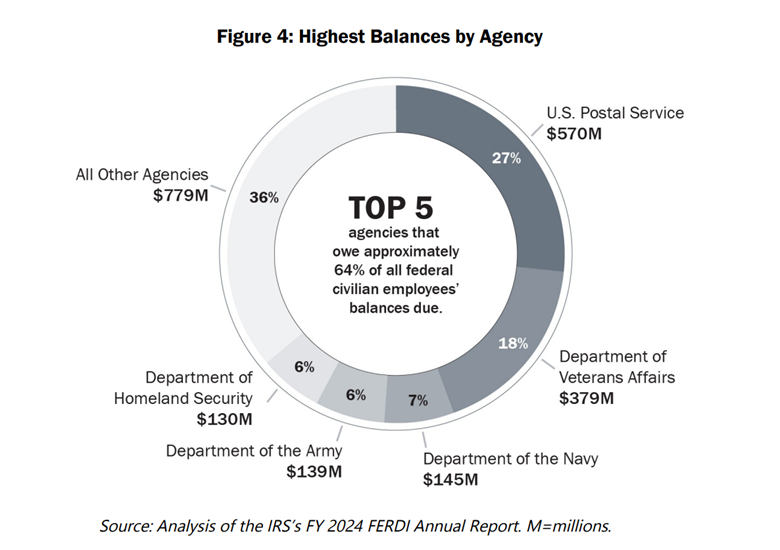
Each of these five executive departments/independent agencies also experienced increases in delinquency rates over those four fiscal years, averaging 1.9 percent.
Bad tax compliance example: Ensuring that taxpayers voluntarily and accurately report their income and pay due taxes is increasingly challenging.
More Americans mistrust all levels of government now. The IRS, which has always been on that list is catching even more heat.
The growing self-employment sector, notably the gig economy component, continues to pose problems for the IRS. It is harder for the agency to track many of these side-job transactions. That has led to income under-reporting and tax under- or non-payments, both intentionally or because of taxpayers’ tax law confusion.
Then there are the country’s general financial concerns. That the growing gap between average citizens and the wealthy also exacerbates feelings of tax unfairness. And that is prompting some to take their chances when it comes to tax filing and paying.
Tax delinquent federal employees and retirees — even within the IRS itself — aren’t new. They are just human, after all.
But when the people we pay with our tax dollars don’t contribute to the Treasury, they add to the anti-tax arguments, put our voluntary tax compliance system under more stress, and make the IRS’ job harder. That concern is cited in the TIGTA FERDI report.
“All taxpayers have a legal obligation to file tax returns and pay their taxes. However, federal employees are held to a higher standard since their compensation is primarily from federal taxes. As the agency responsible for administering federal tax law, the IRS must ensure that federal employees comply with the tax law to maintain the public’s confidence. If taxpayers are aware that federal employees are not tax compliant, it may impact their willingness to comply with their own tax matters.”
Compliance complications: Part of the federal compliance issue is related to the agency’s obvious need to protect all taxpayers’ privacy.
TIGTA says that while “federal employees have a heightened obligation to comply with tax laws,” Internal Revenue Code section 6103 prohibits the IRS from disclosing a tax delinquent employee’s return information to federal agencies outside of the Department of the Treasury.
“This provision protects taxpayers’ rights to privacy, but also prevents federal agencies from becoming aware of and directly addressing employee tax noncompliance,” notes the report. TIGTA has suggested (and noted again in this report) that Treasury’s Office of Tax Policy consider a legislative proposal to amend this tax code section to allow the IRS to share essential return information with other federal agencies any time the tax agency identifies a current federal employee who is tax delinquent.
New, one-off tax notice: In the meantime, IRS Collection officials worked with the tax agency’s counsel and the Treasury Department in May 2025 to create Notice LT36.
This new, and apparently one-time-only notice was sent last summer to approximately 427,000 current or retired federal employees who, as of April 30, 2025, had an outstanding balance or delinquent return and who had not taken steps to resolve their tax issues.
Around 98,000 noncompliant IRS employees or retirees did not get the notice. There were excluded because they had set up payment plans or were under criminal investigation, in a combat zone, or were going through bankruptcy proceedings.
Those who did get Notice LT36 were directed to IRS.gov self-service tools to resolve their delinquent accounts. These options include online taxpayer account access, electronic payment options, and electronic filing resources.
Within 30 days after the notice was sent, the IRS says it collected $58 million in delinquent taxes. Nearly 59,000 taxpayers made a payment, with 4,700 of them paying their overdue balance in full.
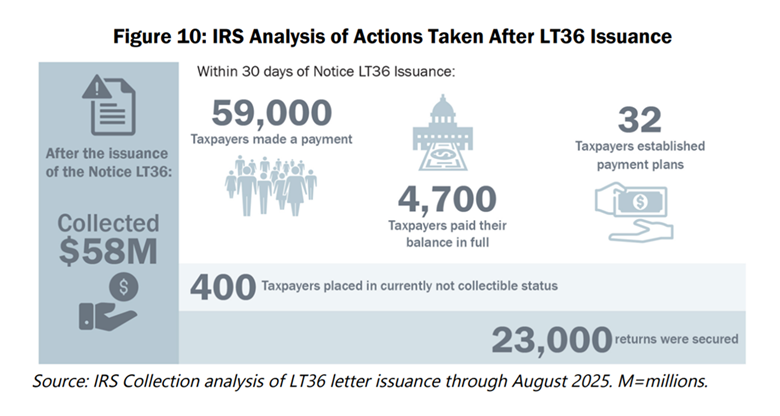
While the delinquent tax collections made just a small dent in the $6.3 billion in taxes owed by federal workers and retirees, it is better than nothing.
Other federal worker compliance plans: The IRS said it cannot attribute the recipients’ payment responses solely to the Notice LT36, and therefore does not plan to issue the notice again.
But Amalia C. Colbert, commissioner of IRS’ Small Business/Self-Employed Division, did acknowledge that “the results suggest targeted outreach can be effective and will inform future compliance strategies.”
Colbert also said in a report follow-up letter to TIGTA that the IRS has “taken a number of actions to strengthen compliance and program performance.” They include implementation of prior FERDI audit recommendations and increased FERDI-specialized automated collection system site casework from one day per quarter to two days per week.
Fingers are crossed that the IRS can come up with a way to get all the agency’s and fellow federal colleagues, current and former, in good tax standing. But I fear we’re going to end up with cramping hands.
…
Advertisements
🌟 Search Amazon Tax Products 🌟
The text link above is an affiliate ad. If you click through and then buy a product, I receive a commission.