Reviewed and updated Monday, June 1, 2026
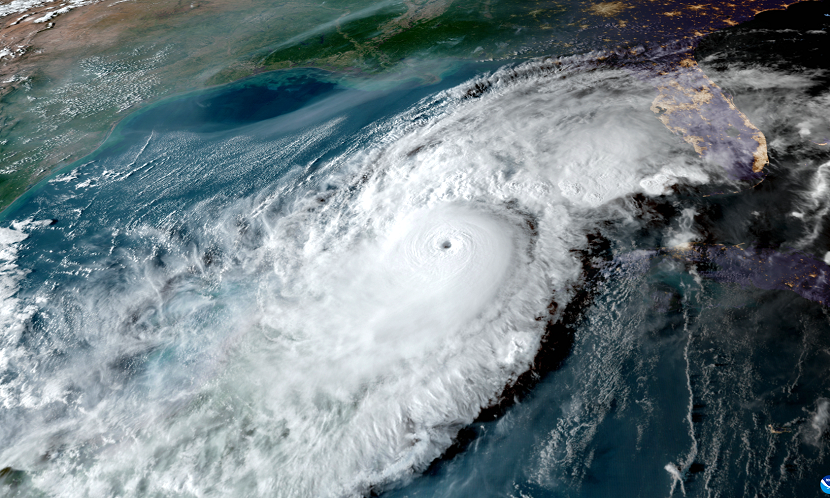
Hurricane season 2026 is officially underway. The good news is that forecasters expect this tropical storm season to be relatively calm.
But, as the old weather saying goes, it only takes one storm. So, regardless of how many or few ‘canes we get this year, now is the time to make your storm preparations.
Part of that possible disaster prep includes taking a pre-disaster inventory of your property.
A full, accurate list of your belongings before Mother Nature does her worst could be invaluable for insurance and possible tax relief purposes.
Many disasters, all destructive: The variety of natural disasters is vast. And each, from hurricane to tornado to blizzard to flood to earthquake to wildfire, has its own destructive potential.
That’s why it’s important to have property insurance that’s adequate and appropriate for the disasters that are prevalent where you live.
Such coverage is even more crucial now that federal tax relief to help with disaster recovery is limited.
The Tax Cuts and Jobs Act (TCJA) that became law in late 2017 changed the prior casualty loss claim rules. Now in order to file an itemized tax deduction claim for disaster losses, the damages must be caused by a federally declared disaster. This claim limitation is in effect through 2025.
That puts property owners who don’t have an insurance policy (or a very good one) in the uncomfortable and counter-intuitive position of wanting any disaster to be truly major so they can get some help from Uncle Sam.
Keeping a loss log: Regardless of whether you are able to claim a major disaster tax deduction (check out my post on Considerations in making a major disaster tax claim) or depend solely on your private insurance coverage, you’ll need to show what the damage cost you.
That’s where a good pre-disaster inventory comes into play. Suggestions on how to do that can be found in IRS Publication 584, Casualty, Disaster, and Theft Loss Workbook (Personal-Use Property).
This 28-page booklet was created to help you figure your loss on personal property if you ever suffer any of these losses. And yes, even though the tax treatment has changed to apply, at least temporarily, to only major natural disasters, the IRS publication retains its original and more expansive title.
Most of Publication 584 is pages to help you figure the dollar loss you can claim on your taxes for qualifying damages. Below is an excerpt of the one to record living room furnishings and items.
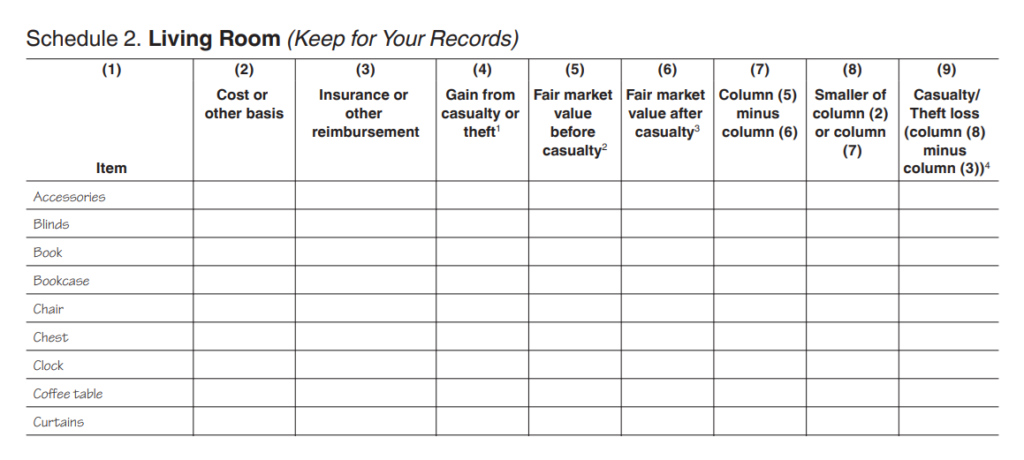
The Publication 584 worksheets provide a good framework for taking inventory of your home and other personal items before you ever sustain a loss.
The worksheets are broken down room by room, starting with your entryway and going through the residence before continuing to pages for vehicles and personal items, such as clothing, jewelry and the ever-popular miscellaneous. The categories are a good memory nudge to account for everything you own and which could be damaged or destroyed if your location is ever the target of a natural disaster.
If you own your own business, also check out Pub. 584’s sister document, Publication 584-B, Business Casualty, Disaster, and Theft Loss Workbook. It has similar worksheets for inventorying equipment in your workplace.
Documenting before and after: Unfortunately, none of the PDF casualty loss publications is fillable. But you can download them and print out the pages you need.
The worksheets share a key similarity. They allow you to note your personal or business property’s value, either cost or other basis and its fair market value, in the tables before it was damaged or destroyed.
After the disaster, you can fill in the other columns: insurance or other reimbursement, any possible gain from the casualty event and the item’s post-disaster fair market value.
By having your property inventory ready to go before you need it, you’ve got a critical head start in getting reimbursed by your insurance company and/or the IRS.
Photos, too: Also take photos, both before any disaster and after you’re hit.
Your digital images are dated and can be uploaded to the cloud for safekeeping, or downloaded to a thumb drive or CD for placement in a weather-proof place out of harm’s way. Remember to make a copy for your emergency kit, too.
These images could help you substantiate any insurance or tax loss claims.
I hope you never have to use your property inventory for insurance or major federal disaster tax claims. But it never hurts to be ready.
Mother Nature, as well know all too well, can turn into a brutal Mommy Dearest year-round.
You also might find these items of interest:
- File major disaster claims on Form 4684
- IRS and other government resources can help you deal with a natural disaster
- Storm Warnings: A guide to preparing for and recovering from natural disasters
Advertisements
🌟 Search Amazon Business and Money Books 🌟
The text link above is an affiliate ad. If you click through and then buy a product, I receive a commission.