Frankie Leon via Flickr
…
Fireworks are the stars each July 4th, but the Stars and Stripes get plenty of attention, too, on Independence Day. Here’s a look at Old Glory’s history, along with some patriotic tax tidbits.
…
While fireworks get the prime spotlight on Independence Day, there’s plenty of U.S. flag waving.
All flags are potent symbols. When it comes to countries, the choice of shapes, colors, emblems, and other embellishments generally provide a shorthand to what the nations they represent hold dear.
When the United States’ Founding Fathers were working to create our country 205 years ago, there were several potential flags being flown as symbols of our soon-to-be independent country.
However, the Betsy Ross flag, with its red and white stripes and circle of stars on a blue background, often celebrated as the first official American flag.
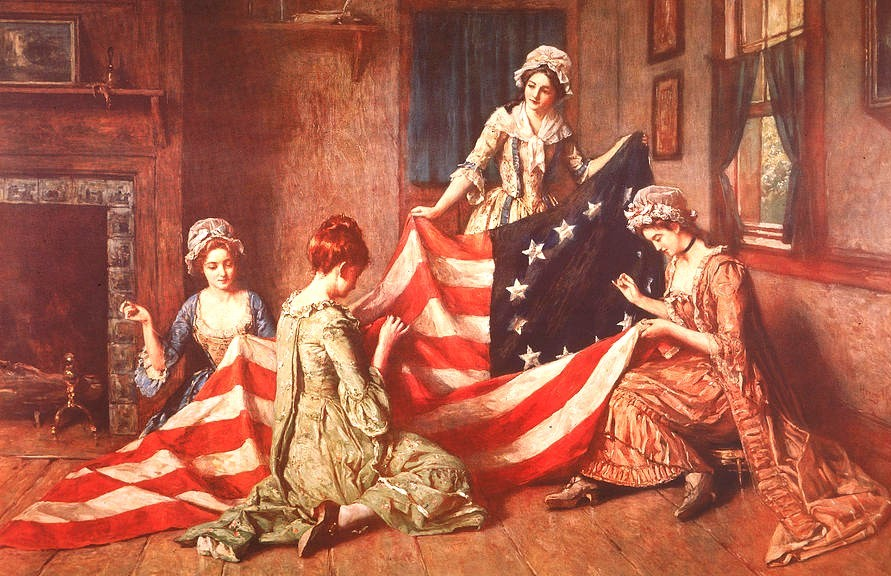
The Birth of the Flag by Henry Mosler. On display at Booth Family Center for Special Collections, University Art Collection, Georgetown University.
…
There’s no conclusive evidence that Philadelphia-born Ross actually designed the flag — that’s the story that the seamstress’ grandson, William Canby, told the Historical Society of Pennsylvania in 1870 — her name became attached to the banner.
The current U.S. flag: On June 14, 1777, the Continental Congress passed an act establishing an official flag for the new nation.
“Resolved, that the flag of the United States be thirteen stripes, alternate red and white; that the union be thirteen stars, white in a blue field, representing a new constellation.”
…
Between that original resolution and 1960 Congress passed several acts that changed the shape, design and arrangement of the flag. The legislative moves allowed stars and stripes to be added to reflect the admission of each new state.
Today, the U.S. flag consists of 13 horizontal stripes, seven red alternating with six white. They honor the original 13 Colonies. The stars in the corner blue section represent the 50 states of the Union.
The flag’s colors also are symbolic. Red is for hardiness and valor. White symbolizes purity and innocence. Blue represents vigilance, perseverance and justice.
And on Aug. 3, 1949, Old Glory got its own official holiday. That’s when President Harry S. Truman officially declared June 14 as Flag Day.
Flying the flag: There are a few locations where the U.S. flag is flown 24 hours a day, by either presidential proclamation or by law. They are —
- Fort McHenry, National Monument and Historic Shrine, Baltimore, Maryland
- Flag House Square, Baltimore, Maryland
- United States Marine Corps Memorial (Iwo Jima), Arlington, Virginia
- On the Green of the Town of Lexington, Massachusetts
- The White House, Washington, D.C.
- United States customs ports of entry
- Grounds of the National Memorial Arch in Valley Forge State Park, Valley Forge, Pennsylvania
Today, millions will wave U.S. flag replicas as part of their celebration of America’s founding 250 years ago with the signing of the Declaration of Independence.

…
So, on this national holiday, the ol’ blog’s special July 4th Saturday Shout Out goes to an article on how each U.S. flag is created.
Washington Post reporters Cleve R. Wootson Jr., Monique Woo and Gavin McIntyre provide the details in their piece, “Each American flag starts with thread. Here’s how they’re made.”
Get your own flag: If you don’t have a U.S. flag, you can find them at retail stores across the county, especially before major holidays.
And to ensure there’s some tax content in this post, let me remind you that some states waive sales tax collection on purchases of a U.S. flag. In some cases, state flags are tax-free, too.
You also can order a U.S. flag that has flown over the U.S. Capitol by contacting your Representative or one of your Senators.
This program is administered by the Architect of the Capitol (AOC), which uses special flag poles where all requested flags are flown. After a flag is flown over the Capitol, the AOC provides a keepsake Certificate of Authenticity to accompany the banner.
Whether you fly your own Stars and Stripes, wave a miniature during today’s celebrations, or just enjoy seeing all the red, white and blue banners and bunting, enjoy today. And be safe, both in dealing with the heat gripping much of the United States and in handling fireworks.
You also might find these previous July 4 blog items of interest:
- Tariffs could dim America’s future fireworks celebrations (July 4, 2025)
- Taxes still part of Independence Day 248 years later (July 4, 2024)
- July 4th spotlight on patriotic national parks (July 4, 2023)
- How to properly fly the U.S. flag (July 4, 2022)
- Delving into the Declaration of Independence (July 4, 2021)
- Not yet independence, freedom or justice for all in America on this July 4th (July 4, 2020)
- Taxes prompted original U.S. fireworks. Founding father ensured they would continue each July 4th (July 4, 2019)
- ‘Taxation without representation is tyranny’ & 12 other tax quotes for the Fourth of July (July 4, 2016)